


Russia’s Ministry for Emergency Services announced on Sunday that it had lifted a tsunami warning for the Kamchatka Peninsula following a powerful earthquake that struck the nearby Kuril Islands.
The magnitude 7.0 quake, confirmed by both the Pacific Tsunami Warning System and the US Geological Survey, initially prompted authorities to issue a precautionary warning and advise residents to stay away from coastal areas. However, wave heights were reported to be minimal, and no significant tsunami threat materialized.
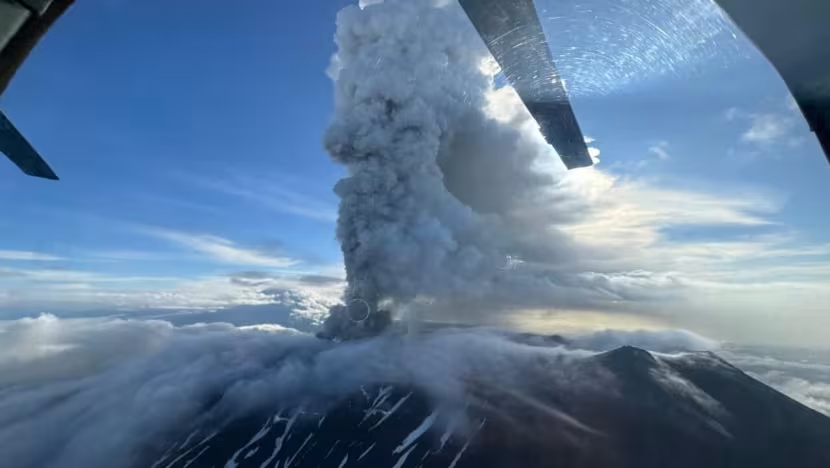
While the immediate danger from the earthquake subsided, attention quickly turned to another geological event in the region. The Krasheninnikov Volcano, located in Kamchatka, erupted for the first time in over 600 years, according to reports from Russia’s RIA state news agency and local scientists. The eruption marks a significant geological development in the region, long known for its seismic and volcanic activity.
Olga Girina, head of the Kamchatka Volcanic Eruption Response Team, confirmed that this is the first historically recorded eruption of Krasheninnikov. She noted that the volcano’s last known lava activity likely occurred around 1463, but no eruptions had been documented since then.
The Kamchatka branch of Russia’s emergency services reported that the eruption produced an ash plume rising up to 6,000 meters (approximately 3.7 miles) into the atmosphere.
According to a statement on the Telegram channel of the Institute of Volcanology and Seismology, the ash cloud has been drifting eastward over the Pacific Ocean. Fortunately, it is not currently threatening any populated areas. Due to the increased volcanic activity, officials have assigned an orange aviation code to the eruption, which signals a moderate to high risk to aircraft in the vicinity.
The events come just days after another powerful earthquake shook Russia’s Far East, prompting tsunami warnings that extended as far as French Polynesia and Chile.
That quake also preceded the eruption of Klyuchevskoy, the most active volcano on the Kamchatka Peninsula. Russian scientists had previously cautioned that strong aftershocks and additional seismic events could occur in the region in the coming weeks.
The Kamchatka Peninsula and Kuril Islands lie along the seismically active “Ring of Fire,” a region in the Pacific Ocean basin where frequent earthquakes and volcanic eruptions occur. These latest incidents serve as stark reminders of the area’s geological volatility and the importance of monitoring systems in place to protect local populations and air traffic.
