

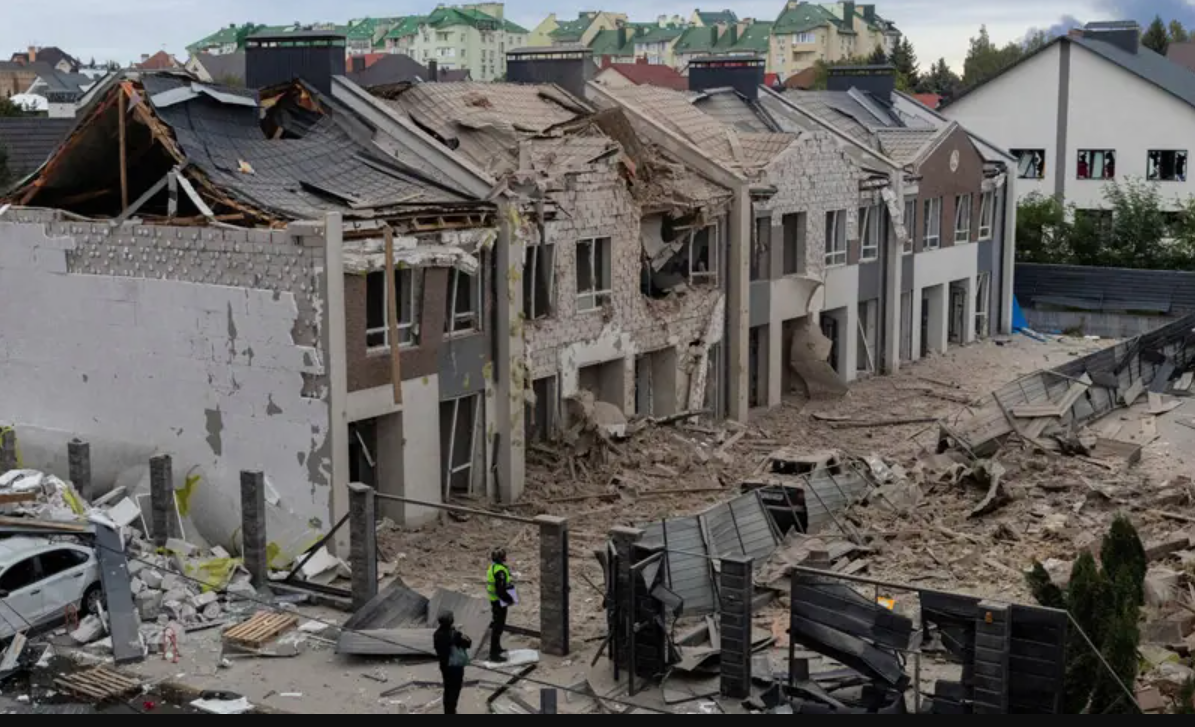

Russia carried out one of its most intense assaults on Ukraine, launching a wave of drone and missile strikes against Kyiv and several other regions. The overnight attack left at least four people dead and dozens more injured. Authorities confirmed that the strikes, which began late Saturday and lasted into Sunday morning, marked one of the heaviest bombardments of Ukraine’s capital since the war began in 2022.
Ukraine’s military reported that Russia launched nearly 600 drones and close to 50 missiles in a single night. Air defence systems successfully intercepted most of them, but some managed to penetrate, causing widespread destruction. Factories, a cardiology clinic, and residential buildings in Kyiv sustained severe damage. Debris from intercepted drones also struck homes and vehicles, leaving residents scrambling to metro stations for safety.
Civilian Areas Hit Hard
In Kyiv’s suburbs, rows of newly built houses were left in ruins, with windows shattered and cars flattened. Emergency services worked tirelessly through the wreckage, pulling survivors from damaged structures. Among the casualties was a young girl, though this report has not yet been officially confirmed by local authorities.
Residents described the night as terrifying, with explosions, drones overhead, and air defence systems booming for hours. Smoke hung in the morning air after the all-clear signal ended around 9 a.m., nearly seven hours after the strikes began.
Widespread Condemnation and International Appeals
Ukrainian President Volodymyr Zelensky condemned the attacks, calling for stronger global action. He emphasized that Russia continues to fund its war effort through energy exports, urging allies to act decisively to cut these revenues. Zelensky highlighted the urgent need for additional air defence systems, pointing to the recent deployment of a Patriot missile system from Israel and the expectation of more this autumn.
He appealed directly to the United States, European Union, and global groups such as the G7 and G20 to take firm measures. According to him, without stronger international support, Ukraine’s limited defences will continue to be stretched by Russia’s large-scale strikes.
Poland’s Emergency Measures
Neighbouring Poland temporarily closed its airspace near two southeastern cities as a precaution. Its air force scrambled jets until the threat had passed. These emergency steps underscore the regional danger posed by Russia’s long-range missile and drone campaigns.
Rising Civilian Toll
While Moscow claims its strikes only target military infrastructure such as airfields, the reality on the ground tells a different story. Thousands of civilians have died since the start of the invasion, with homes, hospitals, and schools repeatedly damaged or destroyed. Sunday’s assault further highlights the heavy toll borne by ordinary Ukrainians.
Local authorities confirmed at least 67 people were wounded across the country during this latest wave. In Zaporizhzhia, one of the hardest-hit southern regions, officials reported at least 16 injuries. Emergency crews continue to work across multiple sites, providing medical care and clearing debris.
Growing Urgency for Air Defence
Ukraine’s calls for advanced air defence systems have grown louder. Officials stress that despite successful interceptions, the sheer scale of Russia’s drone and missile use is overwhelming. While allies have pledged further systems, global shortages and competing security concerns have slowed deliveries.
For Ukraine, however, the message remains clear: without stronger skies, the civilian population will continue to pay the highest price.
