
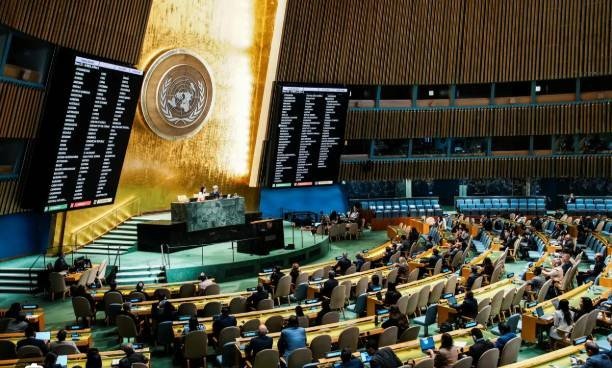

Russia and China Veto Key UN Resolution
Russia and China have vetoed a crucial resolution at the United Nations Security Council regarding the reopening of the Strait of Hormuz. The vote took place on Tuesday and has raised concerns about global shipping security.
The resolution aimed to address disruptions in one of the world’s most important oil routes. The Strait of Hormuz is a critical passage for global energy supplies. Any blockage or instability in this region affects international markets.
Despite being revised and softened, the resolution failed to pass. Russia and China opposed the measure, using their veto power. Their decision effectively blocked the proposal from moving forward.
Gulf States Express Disappointment Over Outcome
The draft resolution was prepared by Bahrain and strongly supported by the United States. It initially included stronger language that could have allowed the use of force to secure the shipping lane. However, the final version was diluted to gain broader support.
In the final vote, 11 members supported the resolution. Two countries voted against it, while two others abstained. Despite majority support, the veto by Russia and China prevented adoption.
Abdullatif bin Rashid Al Zayani expressed regret over the outcome. He stated that Gulf states were disappointed by the rejection. He emphasized the importance of ensuring safe navigation in the region.
The failure of the resolution has left Gulf nations concerned. They believe urgent action is needed to protect vital trade routes.
Global Shipping and Energy Security at Risk
The Strait of Hormuz plays a key role in global oil transportation. A large portion of the world’s oil passes through this narrow waterway. Any disruption can lead to rising energy prices and economic instability.
Experts warn that the lack of consensus at the United Nations Security Council may complicate efforts to stabilize the region. Without coordinated action, tensions could escalate further.
The veto also reflects deeper geopolitical divisions. Major powers remain divided on how to handle security in the Middle East. This division makes diplomatic solutions more difficult.
Analysts believe that alternative strategies may now be considered. Regional alliances or independent actions could emerge to address the issue. However, such moves may carry additional risks.
The situation remains fluid. Global markets and governments are closely monitoring developments. The future of the Strait of Hormuz will likely remain a key international concern.
The failure to pass the resolution highlights the challenges of global governance. It also underscores the importance of cooperation in addressing critical issues.

