

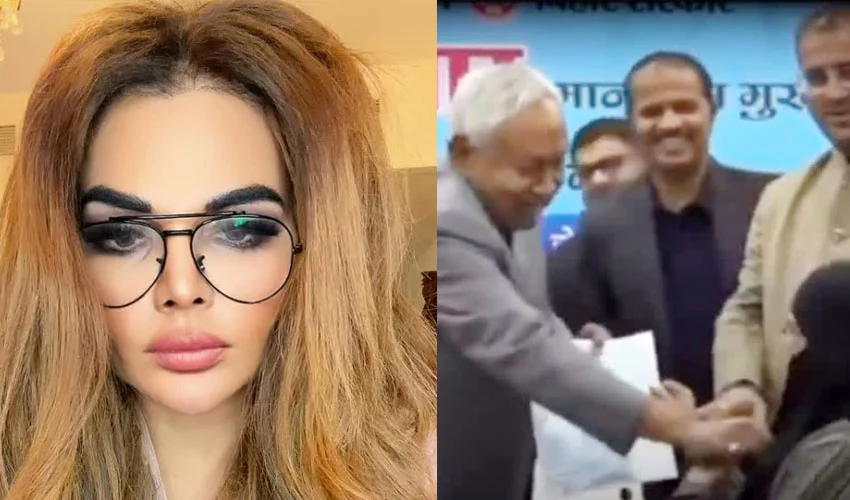

Bollywood personality Rakhi Sawant has strongly criticised Bihar Chief Minister Nitish Kumar following an incident in which he allegedly pulled down the hijab of a Muslim woman during a public award ceremony. The act has sparked widespread outrage and renewed debate over religious sensitivity and respect at official events.
Rakhi Sawant came out in defence of the woman, describing the incident as Islamophobic and deeply disrespectful. Taking to Instagram, the actor and reality television star said that wearing the hijab is an important religious obligation for Muslim women and that forcibly removing it amounts to a serious violation of personal and religious dignity.
In her message, Sawant used a striking analogy to highlight the gravity of the situation. “If someone suddenly pulls down your dhoti in public, would that be acceptable?” she asked, drawing attention to how such an act would be viewed if directed at members of another community. Her remarks quickly gained traction online and went viral, with many users praising her for speaking out boldly.
The controversy erupted during an award ceremony where Nitish Kumar was presenting honours to women achievers. According to reports and video footage circulating on social media, the chief minister appeared to pull down the hijab of a Muslim award recipient in full view of the audience. The moment reportedly left attendees stunned and triggered intense discussion across political and social circles.
The incident has since attracted attention beyond India, with many commentators stressing the importance of respecting religious and cultural practices during public and official functions. Critics argue that such actions undermine inclusivity and foster discrimination.
Rakhi Sawant’s comments have been widely applauded on social media. Several users lauded her courage, with one saying that regardless of how she is perceived, she consistently stands up for what is right. Others described her analogy as powerful and relatable.
Sawant, who recently embraced Islam and performed Umrah, has spoken openly about her faith in recent months. Her defence of the Muslim woman in this case reflects her continued advocacy for religious rights and her willingness to call out behaviour she views as discriminatory.
