

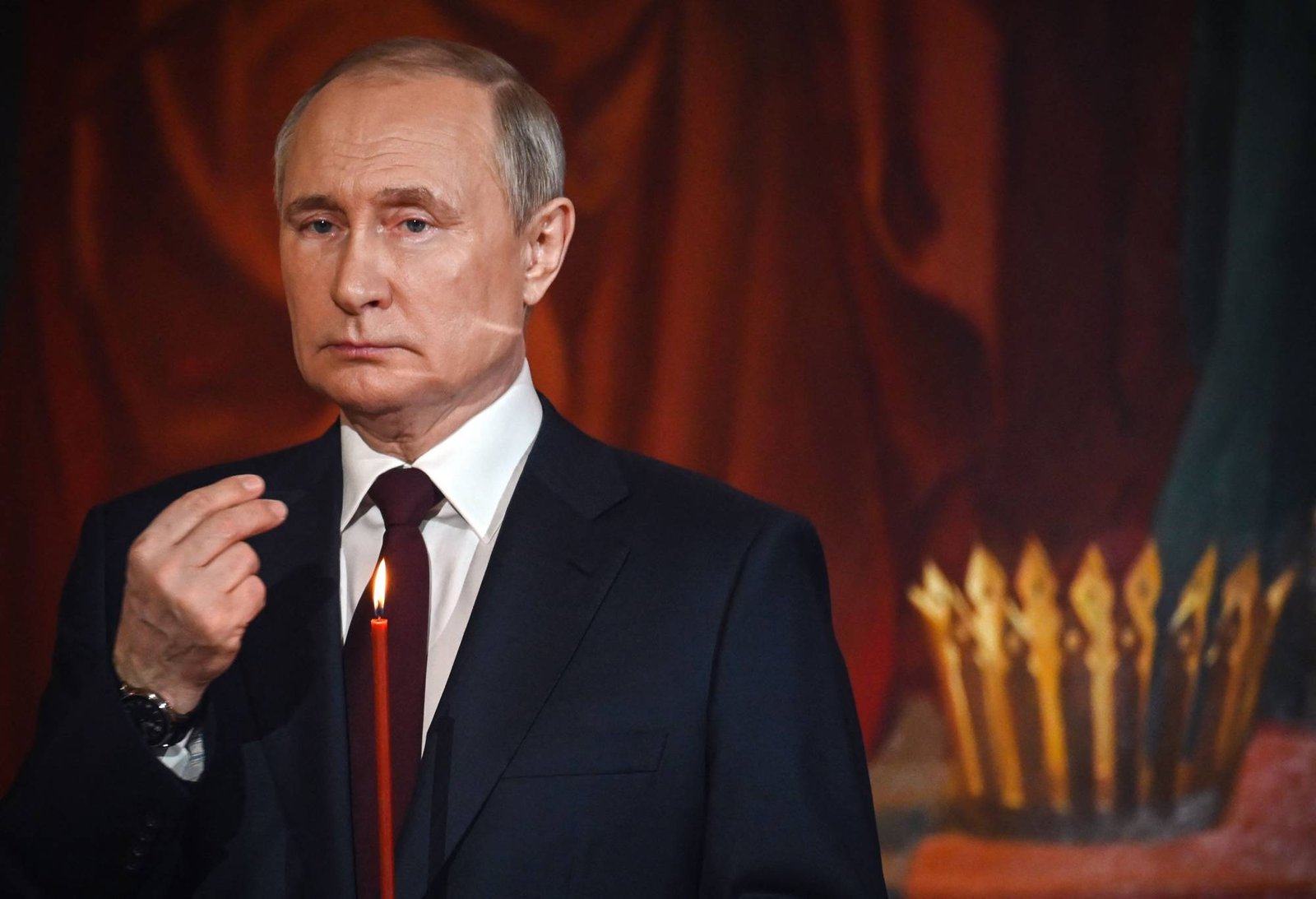

Russian President Vladimir Putin cautioned the West on Monday, emphasizing that a direct confrontation between Russia and the US-led NATO military alliance would dangerously escalate towards World War Three, a scenario nobody desires.
The conflict in Ukraine has plunged Moscow’s relations with the West into their most severe crisis since the Cuban Missile Crisis of 1962. While Putin has frequently highlighted the threat of nuclear war, he asserts that he has never considered using nuclear weapons in Ukraine.
French President Emmanuel Macron recently mentioned the potential deployment of ground troops in Ukraine, a notion met with varied reactions among Western nations, with some distancing themselves while others, particularly in Eastern Europe, expressed support.
Responding to inquiries from Reuters regarding Macron’s remarks and the possibility of a Russia-NATO conflict, Putin remarked, “everything is possible in the modern world.”
“It is evident to all that such a scenario would bring us perilously close to a full-blown World War Three. I doubt anyone truly desires such an outcome,” Putin stated during a press briefing following his record-breaking victory in post-Soviet Russian history.
Putin pointed out the presence of NATO military personnel in Ukraine, noting instances of English and French being spoken on the battlefield.
“There’s nothing positive about this, especially for them, as they are facing casualties, and in significant numbers,” he remarked.
With regards to Ukraine’s Kharkiv region, Putin suggested that continued attacks might prompt Russia to establish a buffer zone encompassing additional Ukrainian territory to safeguard Russian borders.
“I don’t rule out the necessity, given the tragic events unfolding, for us to establish a ‘sanitary zone’ in territories currently under the Kyiv regime,” Putin explained, declining to provide further specifics but indicating the need to prevent foreign-made armaments from reaching Russian soil.
Putin’s decision to launch a full-scale invasion of Ukraine in February 2022 sparked a major European conflict following eight years of skirmishes in eastern Ukraine between Ukrainian forces and pro-Russian factions.
Addressing Macron, Putin expressed a desire for France to shift focus towards peace efforts in Ukraine rather than exacerbating the situation.
“I’ve reiterated it countless times, and I’ll reiterate it again: we advocate for peace talks, not just because our adversary is running low on ammunition,” Putin stressed.
“If they genuinely desire to establish lasting, peaceful, neighborly relations between our nations and not merely pause for rearmament for 1.5-2 years.”
Regarding U.S. democracy, Putin dismissed criticism of the Russian election, countering with critiques of U.S. electoral processes and citing the misuse of state power against Donald Trump.
“The global community is observing with incredulity the events unfolding there,” Putin remarked on the United States. “It’s nothing short of a catastrophe – far from democracy – what exactly is it?”
When questioned about opposition leader Alexei Navalny’s fate, who died under mysterious circumstances in a Russian prison in the Arctic on Feb. 16, Putin simply stated he had “passed away,” mentioning Navalny’s name publicly for one of the first times.
Putin disclosed that he had agreed to a prisoner swap involving Navalny several days before his death. Reports surfaced in February about a negotiated prisoner exchange deal for Navalny shortly before his demise.
“I consented,” Putin said regarding his approval of the swap. “However, I had one condition – his exchange, with the guarantee that he never returns.”
Navalny’s widow, Yulia, has accused Putin of being responsible for her husband’s death, an allegation Kremlin spokesperson Dmitry Peskov refuted, stating it was categorically false.
