

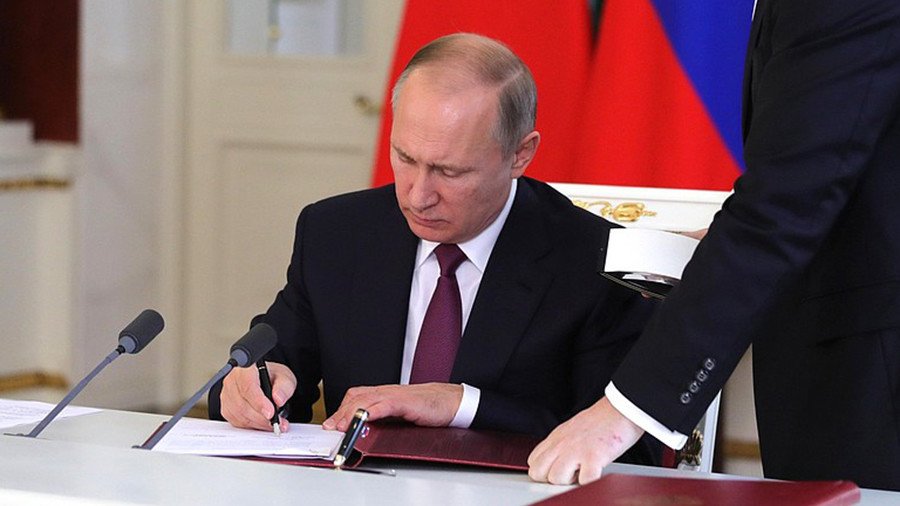

MOSCOW: Russian President Vladimir Putin threatened on Sunday to resume production of intermediate-range nuclear weapons if the United States confirms plans to deploy missiles in Germany or elsewhere in Europe.
“If the United States carries out such plans, we will consider ourselves liberated from the unilateral moratorium previously adopted on the deployment of medium- and short-range strike capabilities,” Putin said during a naval parade in St. Petersburg.
Putin added that Russia is nearing the final stages of developing several such systems.
“We will take mirror measures in deploying them, taking into account the actions of the U.S., its satellites in Europe, and in other regions of the world,” the Russian president warned.
These missiles, which can travel between 500 and 5,500 kilometers (300-3,400 miles), were previously governed by an arms control treaty signed by the U.S. and the Soviet Union in 1987. However, both Washington and Moscow withdrew from the Intermediate-Range Nuclear Forces Treaty in 2019, accusing each other of violations.
Following the treaty’s dissolution, Russia stated it would not restart missile production as long as the United States refrained from deploying missiles abroad.
In early July, Washington and Berlin announced that “episodic deployments” of long-range U.S. missiles, including Tomahawk cruise missiles, to Germany would begin in 2026.
Putin emphasized that such missiles could place “important Russian administrative and military sites” within range of a strike that could potentially be equipped with nuclear warheads, reducing response time to around 10 minutes.
The Russian president also noted that the U.S. has deployed Typhon mid-range missile systems in Denmark and the Philippines during recent exercises.
“This situation reminds us of the events of the Cold War linked to the deployment of American Pershing medium-range missiles in Europe,” Putin said.
In the 1980s, at the height of the Cold War, the U.S. deployed Pershing ballistic missiles in West Germany. These missiles remained stationed through Germany’s reunification and into the 1990s. However, following the end of the Cold War, the United States significantly reduced the number of missiles stationed in Europe as the perceived threat from Moscow diminished.
The Kremlin had already warned in mid-July that the proposed U.S. missile deployment would make European capitals targets for Russian missiles.
“We are taking steady steps towards the Cold War. All the attributes of the Cold War with the direct confrontation are returning,” Kremlin spokesman Dmitry Peskov told a state TV reporter.
