
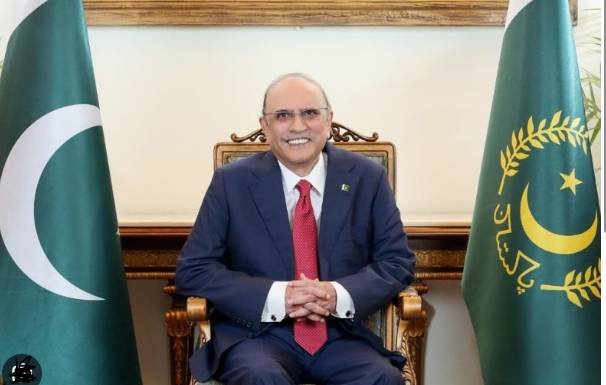

Pakistan Will Defend Its Sovereignty and Regional Peace
President Asif Ali Zardari declared that Pakistan will not allow any entity to use neighbouring territory to destabilise its peace. He delivered the warning during his annual address to a joint sitting of parliament. He said war is always a last resort. He urged India to shift from confrontation to meaningful negotiations.
“Make no mistake. We are ready for you,” the president stated firmly. He said Pakistan had already shown India and Afghanistan only a fraction of its capabilities. He warned that any aggression would meet a decisive response. He added that regional security depends on dialogue, not military escalation.
The session was co-chaired by Yousuf Raza Gilani and Sardar Ayaz Sadiq. Prime Minister Shehbaz Sharif attended along with lawmakers and diplomats. Opposition members staged protests during the speech.
President Zardari reaffirmed Pakistan’s diplomatic and moral support for the people of Jammu and Kashmir. He said peace in South Asia would remain elusive until Kashmiris gain their rights. He criticised India’s suspension of the Indus Waters Treaty. He called it hydro-terrorism and a violation of international law.
He stressed that Pakistan is a responsible nuclear state. However, he said the country would defend itself decisively when required. He cautioned Indian leaders against preparing for another war. He warned that any aggressor should be ready for another humiliating defeat.
Strong Message on Middle East Crisis and Counterterrorism
President Zardari condemned the war against Iran. He reaffirmed Pakistan’s support for Iran’s sovereignty and territorial integrity. He also condemned attacks on Gulf countries including Saudi Arabia, the UAE, Bahrain, Jordan, Kuwait and Qatar. He called for restraint and respect for international law.
He urged all sides to choose negotiations over escalation. He said stability in the Gulf region is vital for global peace. He stressed that territorial integrity of all nations must be respected.
Discussing Operation Ghazab lil-Haq, the president said Pakistan exhausted diplomatic channels before responding to cross-border terrorism. He stated that terrorist groups were operating from Afghan territory. He accused the Afghan Taliban regime of failing to dismantle sanctuaries for groups like Al-Qaeda, BLA and TTP.
He said Pakistan would never tolerate repeated attacks on its soil. “The soil of Pakistan is sacred,” he declared. He added that no foreign or domestic entity would be allowed to destabilise the country.
Foreign Policy, Economy and Democratic Vision
President Zardari highlighted Pakistan’s evolving foreign policy. He appreciated de-escalation efforts between Pakistan and the United States. He said bilateral cooperation with Washington was expanding in trade and investment.
He praised Pakistan’s strategic partnership with China and thanked President Xi Jinping for continued support. He said CPEC 2.0 would transform infrastructure and connectivity.
The president also reaffirmed support for Palestine. He called for an independent state with Al-Quds Al Sharif as its capital. He emphasised solidarity with Gulf allies and regional partners.
On the domestic front, he said the economy had stabilised after severe challenges. He called for inclusive growth and job creation. He urged reforms in taxation, energy and agriculture. He stressed climate resilience and water management.
He highlighted the importance of the Benazir Income Support Programme to empower vulnerable families. He called for women’s economic participation and digital access.
Concluding his address, President Zardari urged unity and reform. He said Pakistan must protect sovereignty, eliminate terrorism and strengthen democratic institutions. He called for cooperation to ensure long-term stability and prosperity.

