


President Trump
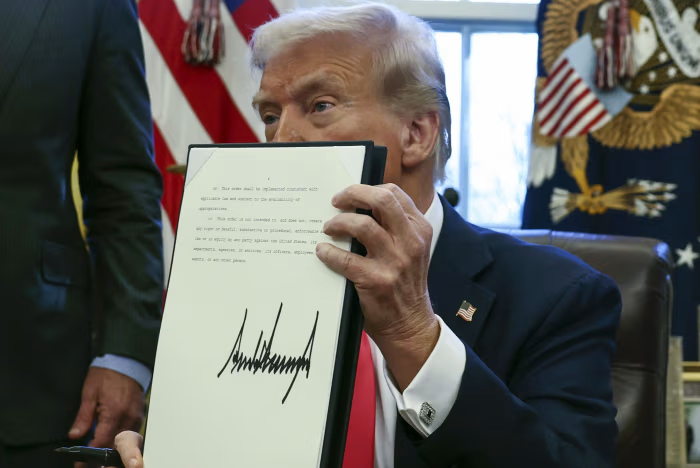
WASHINGTON: President Donald Trump has officially designated English as the United States’ official language, emphasizing that such a move would promote unity in a country known for its diverse immigrant population.
The White House issued an executive order stating that it is “long past time” for English to be declared the nation’s official language, arguing that a common language fosters social cohesion and strengthens national identity.
According to the executive order, a designated national language is fundamental to a unified and cohesive society. The document asserts that the United States is strengthened when its citizens can freely communicate and exchange ideas in a shared language. This policy marks a significant shift from previous mandates that required government agencies to provide multilingual support.
One of the key changes introduced by Trump’s order is the revocation of a presidential directive from the 1990s, issued under then-President Bill Clinton.
That mandate required federal agencies and organizations receiving federal funding to offer assistance to non-English speakers. Under Trump’s directive, government agencies will now have the discretion to determine the extent of language assistance they provide.
However, the order clarifies that no immediate changes are mandated regarding the services offered by federal agencies. Agency heads retain the authority to assess what is necessary to fulfill their respective missions and provide government services efficiently.
This means that while English is formally recognized as the official language, agencies can still offer language support at their own discretion based on operational needs.
Trump’s administration has been marked by a flurry of executive orders, many of which aim to reshape national policies in alignment with his conservative agenda.
Some of these orders, particularly those seeking to alter federal funding allocations, have faced legal challenges in court. It remains to be seen whether this latest executive action will encounter similar resistance.
The executive order acknowledges that more than 350 languages are spoken in the United States, reflecting the nation’s deep linguistic diversity. While English remains the predominant language, government data from 2019 indicates that nearly 68 million people speak a language other than English at home.
Spanish, in particular, is spoken by over 40 million residents, making it the most widely spoken non-English language in the country. Additionally, various immigrant communities, including Chinese and Vietnamese speakers, contribute to America’s linguistic landscape, alongside numerous Native American languages.
Trump’s decision to formalize English as the national language reinforces longstanding debates about language policy in the United States.
Supporters argue that it promotes national unity and streamlines government operations, while critics warn that it may marginalize non-English-speaking communities and limit access to essential services.
The long-term implications of this executive order remain uncertain, but it undoubtedly marks a significant shift in the government’s approach to language policy.
