

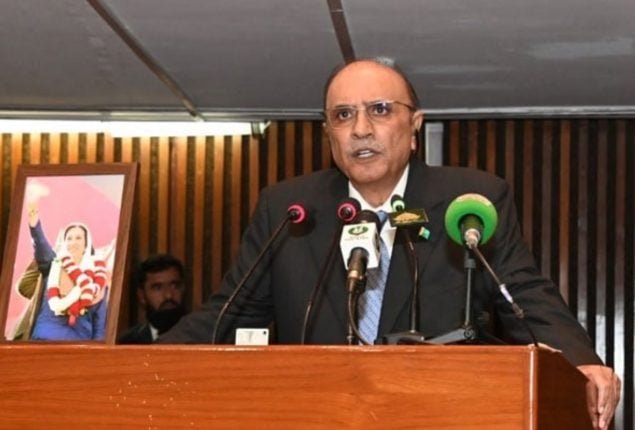

In his address to the joint session of parliament, President Asif Ali Zardari called on stakeholders to put national interests first and set aside political and personal differences for the country’s betterment. His speech, marking the start of the second parliamentary year, came amid a noisy protest by opposition lawmakers, who raised slogans against the government throughout the session.
Zardari emphasized the need for unity in addressing Pakistan’s challenges, urging all parties to work together to revive the economy, strengthen democracy, and uphold the rule of law. “Let us work together to rebuild our economy and strengthen our democracy,” he said.
In his opening remarks, Zardari expressed gratitude for addressing parliament for the eighth time, noting that this occasion marked not only the continuation of the democratic journey but also an opportunity to reflect on progress and reaffirm the commitment to a better future for Pakistan.
He urged lawmakers to focus on good governance, political stability, and economic growth to meet the expectations of the citizens who place their hopes in the parliament. Zardari acknowledged the government’s efforts in putting Pakistan on a positive path to economic growth, pointing to rising foreign exchange reserves, increased foreign direct investment, a historic surge in the stock market, and a reduction in the policy rate from 22% to 12%.
Highlighting the importance of democracy, the president remarked that “democracy requires give and take,” and emphasized that parliament was the best place for collective goals to be worked on. “As elected representatives, you serve as role models for the nation. Think beyond narrow goals and work for the unity and consensus that our country desperately needs.”
Zardari urged the government to encourage both domestic and international investments, promote social and economic justice, and ensure fairness and transparency in the system. He also stressed the need for inclusive and uniform development, ensuring that no region, province, or village is left behind in the country’s progress.
He pointed out that the federal government must address the needs of neglected areas, including investments in infrastructure, education, healthcare, and economic opportunities to tackle regional disparities.
Tax Reforms and Export Diversification
The president also highlighted the importance of tax reforms, urging the expansion of the tax net in a way that does not burden existing taxpayers but ensures that every eligible individual contributes to nation-building. He also emphasized the need to diversify exports, particularly by focusing on value-added goods and services, and making Pakistan’s IT industry a key driver of economic growth.
Zardari also stressed the need to provide sustained support for Small and Medium Enterprises (SMEs) and encourage young people to enter the business world through SME-focused programs, skill development, and accessible loan schemes.
Addressing Economic Hardships
Acknowledging the economic hardships faced by workers and salaried individuals due to inflation, high prices of essentials, and rising energy costs, Zardari called on parliament and the government to provide real relief to the people in the upcoming budget. He suggested increasing salaries and pensions, reducing income taxes for salaried individuals, and lowering energy costs to ease the financial burden on citizens. He also urged the government to avoid downsizing and focus on creating jobs and utilizing skilled labor productively.
Empowering Women and Enhancing Connectivity
Zardari also called for greater empowerment of women, who make up nearly half of the population but remain underrepresented in various sectors. He urged the government to enhance women’s representation in different spheres of life.
He emphasized that domestic and regional connectivity is key to a prosperous Pakistan, highlighting the need for strong transport infrastructure and modernized railways. He specifically pointed out that Gilgit-Baltistan and Balochistan, vital to Pakistan’s economy and security, require special attention in terms of connectivity and development.
Climate Challenges and Security Concerns
On the issue of climate change, the president urged the government to focus on restoring biodiversity, promoting renewable energy, and preserving ecosystems. He also called for strategic investments in recharging wetlands and rivers to support livelihoods and marine ecosystems.
Regarding security, Zardari emphasized strengthening law enforcement agencies to tackle terrorism and extremism. He urged parliament to rebuild consensus to confront these challenges and reiterated the government’s commitment to eradicating terrorism with the support of the armed forces.
Strengthening Foreign Relations
The president highlighted the importance of strengthening relations with neighboring countries and international partners. He reaffirmed Pakistan’s commitment to regional peace, stability, and economic integration, particularly through the China-Pakistan Economic Corridor (CPEC) and Gwadar Port.
He also emphasized the importance of cooperation with friendly countries like China, Saudi Arabia, UAE, Turkey, and others, while recognizing the support from these nations during times of economic challenges. Zardari expressed his intention to further cement ties with the Gulf, Central Asia, the European Union, the United Kingdom, and the United States.
Addressing Federal Unity
In his concluding remarks, Zardari cautioned the government and parliament about the strain caused by unilateral decisions, such as the proposed carving of more canals from the Indus River System, despite strong opposition from federating units. He called for the abandonment of this proposal and urged the government to work collaboratively with all stakeholders to find sustainable solutions based on consensus.
Zardari stressed that the national interest must take precedence over personal and political differences, urging lawmakers to strive for a just, prosperous, and inclusive Pakistan as they work throughout the parliamentary year.
