

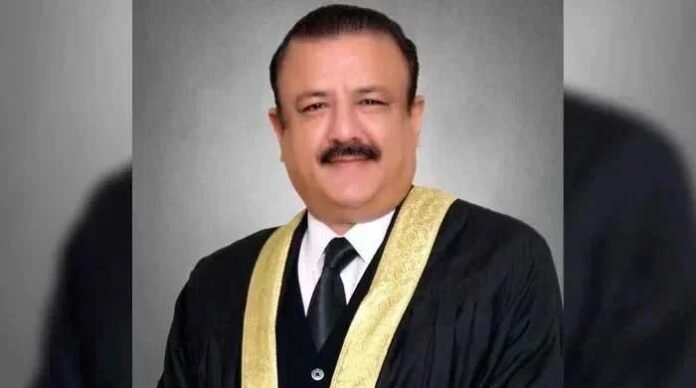

President Asif Ali Zardari on Friday approved the de-notification of Islamabad High Court (IHC) judge Justice Tariq Mehmood Jahangiri on the advice of Prime Minister Shehbaz Sharif, formally ending the judge’s tenure following a landmark court ruling.
The approval came a day after the IHC declared Justice Jahangiri’s appointment unlawful, holding that it failed to meet mandatory legal requirements. Acting on the verdict, the Ministry of Law and Justice issued the notification to remove and de-notify the judge.
Court Declares Appointment Unlawful
In its detailed judgment issued on Thursday, the IHC directed Justice Jahangiri to vacate office after finding that he did not possess a valid LLB degree at the time of his appointment. The court ruled that the absence of a legally recognised law degree rendered his elevation to the bench void ab initio.
A two-member bench led by IHC Chief Justice Sarfraz Dogar, and comprising Justice Azam Khan, announced the decision. The bench also instructed the Ministry of Law and Justice to take immediate steps to implement the ruling.
Degree Controversy at the Centre
The case revolved around the cancellation of Justice Jahangiri’s LLB degree by the University of Karachi. According to a university notification dated September 25, the syndicate, in a meeting held on August 31, 2024, approved Resolution No 6, endorsing the recommendations of the Unfair Means Committee.
The university stated that it acted in compliance with the decision of the competent authority, leading to the cancellation of the degree that formed the basis of Justice Jahangiri’s eligibility for judicial office.
Arguments and Allegations in Court
Justice Jahangiri did not appear in person during the hearing. His counsel, Advocate Akram Sheikh and Barrister Salahuddin, represented him and raised objections regarding the composition of the bench and alleged violations of due process.
Barrister Salahuddin argued that multiple petitions relating to Justice Jahangiri were pending and sought an indefinite adjournment along with 30 days to submit replies. Advocate Sheikh alleged bias and claimed that the chief justice had personal interest in the matter, noting that cases against the CJ were pending before constitutional forums.
On the other hand, Advocate Mian Dawood contended that the Supreme Court’s jurisprudence empowered courts, in writs of quo warranto, to scrutinise every document relating to a judge’s appointment. He alleged that Justice Jahangiri had taken a false oath and challenged the authenticity of his enrolment and academic records.
University Submits Records
Karachi University Registrar Imran Siddiqui appeared before the court and submitted original academic records. He confirmed that the university had finally cancelled the degree, though he acknowledged it was not termed a “fake” degree but one annulled on procedural grounds. Siddiqui also informed the court that the principal of Islamia Law College stated Justice Jahangiri had not been its student.
Despite defence arguments citing a stay order from the Sindh High Court, the IHC concluded that the legal requirements for appointment had not been met, paving the way for the judge’s removal.
