

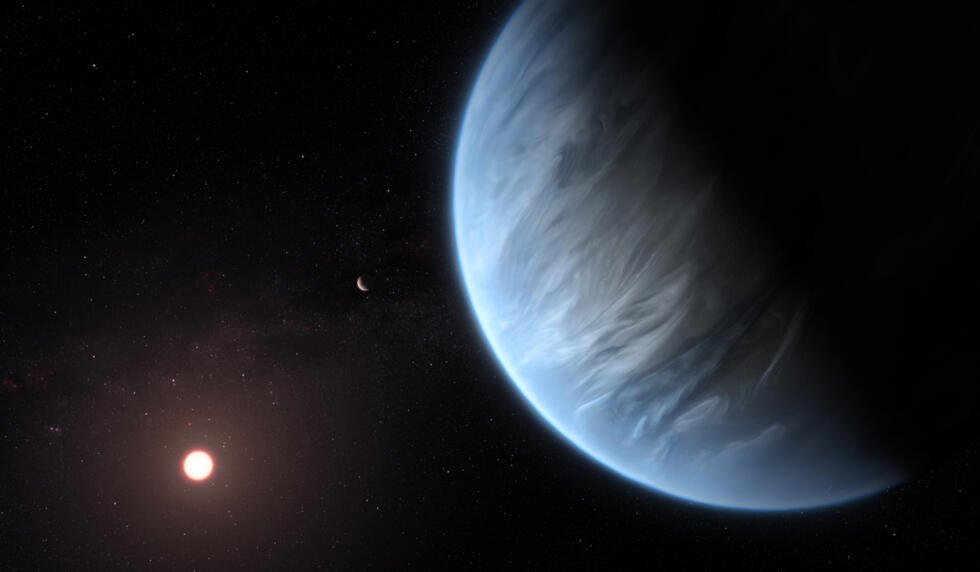

ISLAMABAD: In a potential landmark discovery, scientists using the James Webb Space Telescope have detected chemical signatures in the atmosphere of an exoplanet that, on Earth, are exclusively produced by living organisms. The findings center on K2-18 b, a distant world that may host microbial life, though researchers emphasize that further evidence is needed before drawing definitive conclusions.
The telescope identified traces of dimethyl sulfide (DMS) and dimethyl disulfide (DMDS), gases typically generated by marine microbes such as phytoplankton. K2-18 b is classified as a “hycean world,” a theoretical type of exoplanet with a hydrogen-rich atmosphere and a vast liquid water ocean—conditions that could support microbial life. Previous observations by the Webb telescope had already detected methane and carbon dioxide in the planet’s atmosphere, reinforcing the possibility of a habitable environment. The detection of these new gases carries a confidence level of 99.7%, meaning there remains a slight chance the signal could be a statistical anomaly.
Lead researcher Nikku Madhusudhan, an astrophysicist at the University of Cambridge, described this as a “transformational moment” in the search for extraterrestrial life. However, he stressed that the findings do not confirm the presence of life but rather indicate a potential biosignature requiring further investigation. He noted that if life exists on K2-18 b, it would most likely be microbial, similar to organisms found in Earth’s oceans. Still, alternative explanations must be explored before reaching any conclusions.
K2-18 b is located 124 light-years away in the constellation Leo, orbiting a red dwarf star within the habitable zone where liquid water could exist. The planet is 8.6 times more massive than Earth and 2.6 times wider, placing it in the “sub-Neptune” category. Its hydrogen-rich atmosphere and potential warm ocean make it a strong candidate for the hycean world hypothesis, which posits that such planets could harbor life.
The discovery was made using the transit method, where astronomers analyzed starlight passing through K2-18 b’s atmosphere as it crossed in front of its host star. The telescope detected subtle changes in the light spectrum, revealing the chemical composition of the atmosphere.
While the findings are promising, independent scientists urge caution. Christopher Glein of the Southwest Research Institute called the data compelling but emphasized the need for further verification. Madhusudhan’s team plans additional observations to confirm the signal and rule out non-biological sources for the detected gases.
If confirmed, this would represent the most compelling evidence yet of potential life beyond our solar system. Though K2-18 b is unlikely to host complex life, the discovery could mark a significant step toward identifying biosignatures on Earth-like exoplanets in the future. Madhusudhan reflected on the broader implications, noting that humanity has long wondered whether we are alone in the universe. Now, we may be closer than ever to an answer—but for now, the search continues with cautious optimism.
