


Pakistan’s rapid population growth is hindering its development and the well-being of its citizens. While there is a growing demand for family planning (FP), access to essential services remains limited, especially for marginalized communities. To address this challenge, the Population Council initiated a family planning voucher program for beneficiaries of the Benazir Income Support Program (BISP), which is now being scaled up in Punjab by the Punjab Population Innovation Fund (PPIF).
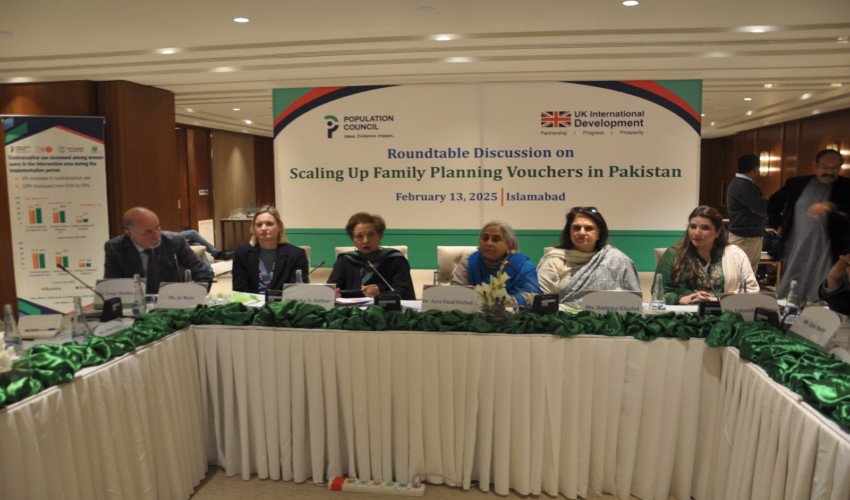
To explore the potential for expanding these efforts through social protection agencies, the Population Council Pakistan organized a high-level roundtable titled “Scaling Up Family Planning Vouchers in Pakistan.” The event brought together government officials and development partners to discuss ways to enhance access to family planning services for underserved communities.
Senator Rubina Khalid, Chairperson of BISP, served as the chief guest, with Dr. Azra Fazal Pechuho as the Guest of Honor. Other notable speakers included Ms. JahanAra Watto, Vice Chairperson of the Punjab Social Protection Authority; Mr. Liaqat Ali, Advisor to the Chief Minister of Khyber Pakhtunkhwa on Population Welfare; Dr. Ijaz Nabi, Member of the Prime Minister’s Economic Advisory Council; and Dr. Luay Shabaneh, Country Representative of the UNFPA.
Participants emphasized the crucial role of social protection authorities in delivering family planning services, as outlined in the national population action plan endorsed by the Council of Common Interest (CCI). The plan aims to address the unmet need for family planning in disadvantaged communities.
Senator Rubina Khalid stated, “Through our Kafaalat and Nashonuma programs, we are committed to improving the well-being of women and children. Our National Socioeconomic Registry helps us provide essential support to the most vulnerable members of society.” She highlighted the importance of family planning services in remote and marginalized areas.
Dr. Azra Fazal Pechuho highlighted the benefits of voucher programs, stating, “These programs enable us to reach women who face barriers to accessing family planning services, allowing them to make informed choices about their reproductive health.” She also stressed the importance of integrating family planning into existing programs like Mamta and Aghosh, advocating for in-kind services over conditional cash transfers.
Dr. Zeba Sathar, Country Director of Population Council Pakistan, emphasized the urgency of scalable interventions. “Despite years of commitments, progress on family planning has been insufficient. With nearly six million unplanned pregnancies annually and 3.8 million women resorting to induced abortions, urgent action is needed.” She also praised the Rahim Yar Khan voucher pilot as an effective model for directing resources to underserved populations.
Jo Moir, Development Director at the UK Foreign, Commonwealth & Development Office (FCDO), noted the success of the DAFPAK Program, which has reached over 10.8 million women across Pakistan since 2017. However, she pointed out that cultural and societal barriers remain significant challenges. Moir reaffirmed the UK’s commitment to supporting scalable and impactful family planning initiatives.
Liaqat Ali Khan emphasized the importance of collaboration between federal and provincial governments to achieve family planning goals. He advocated for incentive-based approaches rather than coercive measures to promote family planning.
The event also featured presentations on successful family planning voucher programs. Ms. Iram Kamran, Director of Programs at the Population Council, shared insights from the Rahim Yar Khan pilot, which utilized the “Karen Zindagi Asaan” mobile app for voucher management, significantly boosting family planning service uptake. Additionally, social protection models from various provinces were discussed.
Dr. Ijaz Nabi praised the success of the voucher program, supported by BISP, and emphasized the need to scale up these initiatives for greater impact.
The roundtable concluded with a consensus on the importance of collaboration, evidence-based policymaking, and the scaling of proven family planning voucher models. The Population Council reaffirmed its commitment to supporting the government’s efforts with data-driven interventions to address reproductive health challenges in Pakistan.
