

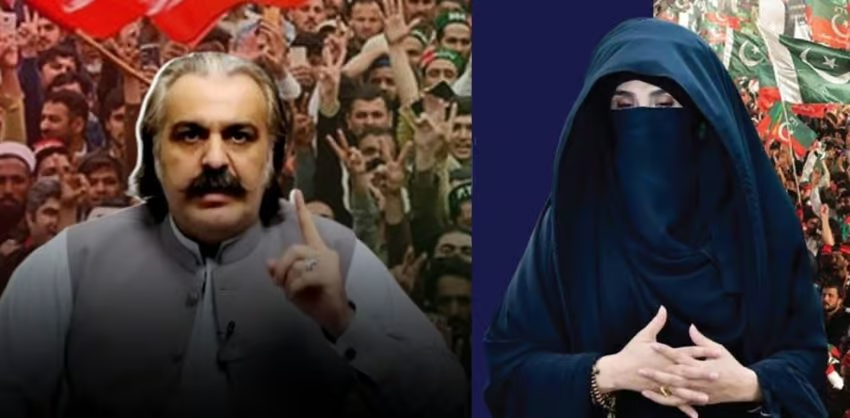

ISLAMABAD: Political activity has intensified in Khyber Pakhtunkhwa following the resignation of Chief Minister Ali Amin Gandapur, as the province braces for a new political showdown. Efforts are now underway to elect a new provincial chief executive, with multiple factions strategizing to secure the top position.
PTI Nominates Suhail Afridi for Chief Minister
The Pakistan Tehreek-e-Insaf (PTI) has nominated Suhail Afridi as its candidate for chief minister. However, what appears to be a simple decision is, in reality, a complex political challenge. Despite holding a numerical edge in the assembly, PTI faces internal rifts and uncertainty over the loyalty of its members.
Governor Faisal Karim Kundi has formally received Gandapur’s resignation. He is expected to convene a session of the provincial assembly soon to dissolve the current government and begin the official process of electing a new chief minister.
Numbers Game Defines the Power Balance
The Khyber Pakhtunkhwa Assembly has 124 members, and a candidate requires at least 73 votes to secure the top post. Although PTI holds 92 seats, 35 members are now classified as independents, meaning they are not bound by party directives.
Reports indicate that 22 lawmakers have submitted separate affidavits, revealing signs of internal discord within PTI’s ranks. Meanwhile, the opposition commands 53 seats. If opposition parties manage to gain 20 more votes, the balance of power could shift dramatically in their favor.
Opposition Seeks a Consensus Candidate
Opposition parties, led by Dr. Ibadullah, have convened an emergency meeting to finalize a consensus candidate. Their strategy focuses on uniting independents and smaller groups to challenge PTI’s dominance.
Afridi Intensifies Political Outreach
PTI’s nominee, Suhail Afridi, has launched intensive consultations, meeting with Speaker Babar Saleem, cabinet members, and senior party figures over the past 24 hours. The PTI leadership aims to rally support and prevent vote splitting when the assembly convenes.
At the same time, the opposition bloc has accelerated its own negotiations, reaching out to independent lawmakers to forge a broader alliance. Political analysts believe that the support of independents could prove decisive, potentially reshaping Khyber Pakhtunkhwa’s political landscape.
