

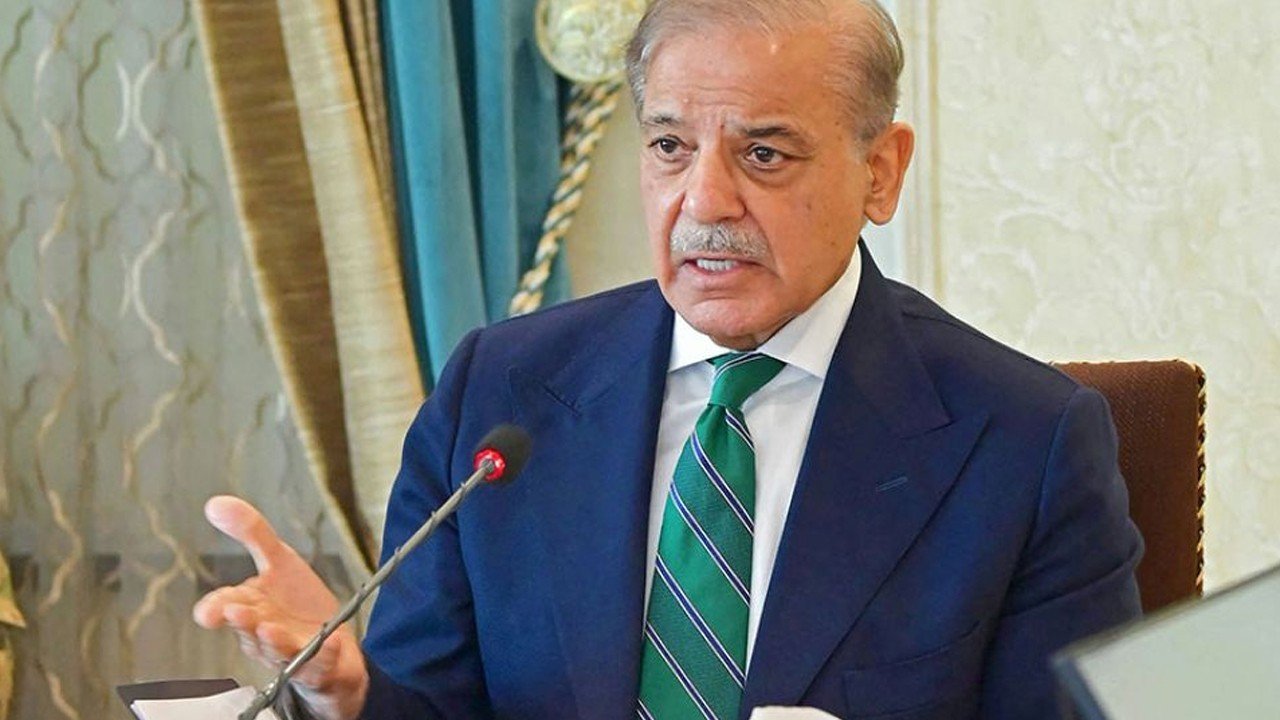

Prime Minister Shehbaz Sharif issued a stern warning to India on Tuesday, asserting that no amount of water from the Indus River could be taken from Pakistan amid growing tensions over hydropower resources in the region.
Speaking at a ceremony in Islamabad, the prime minister made it clear that any attempt by India to interfere with Pakistan’s rightful share of water would be met with strong resistance.
The warning comes against the backdrop of India’s move in April to hold the Indus Waters Treaty (IWT) in abeyance. This decision followed the attack in Pahalgam, occupied Kashmir, which resulted in the deaths of 26 people—a tragedy India blamed on Pakistan, although no concrete evidence was presented.
Pakistan strongly condemned India’s suspension of the treaty, calling it an “act of war,” and pointed out that the treaty has no provisions allowing for unilateral suspension by either party. Pakistan has also signaled its intention to take legal action, citing violations of the 1969 Vienna Convention on the Law of Treaties.
In June, the Permanent Court of Arbitration (PCA) in The Hague issued a supplemental award confirming that India cannot unilaterally put the treaty on hold. India, however, rejected the court’s authority and decisions. Just a day prior to the prime minister’s remarks, the PCA issued another award emphasizing India’s obligation to allow the waters of the western rivers to flow freely for Pakistan’s “unrestricted use.”
At the ceremony, Prime Minister Shehbaz Sharif addressed India directly, saying, “If you threaten to hold our water, then keep this in mind that you cannot snatch even one drop from Pakistan.” He warned that any such action would provoke a forceful response, stating, “You will be again taught such a lesson that you will be left holding your ears.” He further highlighted Pakistan’s military strength by recalling that Pakistan’s air force had shot down six Indian jets, including four Rafales, during recent conflict.
The prime minister’s remarks echoed sentiments expressed by former foreign minister and PPP Chairman Bilawal Bhutto-Zardari, who described India’s suspension of the IWT as an attack on the Indus Valley civilization. Bilawal vowed that Pakistan would never back down and warned that all provinces would unite to defend the river.
Similarly, Chief of Army Staff Field Marshal Syed Asim Munir, during a visit to the United States, reaffirmed Pakistan’s resolve to protect its water rights. He reportedly stated that Pakistan would not hesitate to destroy any Indian dam built on the Indus River, emphasizing that the river does not belong to India and that Pakistan possesses the necessary resources to counter such moves.
Aside from water issues, Prime Minister Shehbaz also acknowledged the contributions of minority communities in Pakistan’s independence and development, praising Christians, Hindus, Sikhs, and Parsis present at the event. He encouraged the youth to actively participate in the nation’s progress and announced the distribution of 100,000 laptops to high-achieving students nationwide.
Reflecting on the recent conflict with India, the prime minister stated, “The way we smashed the enemy in this conflict, they will remember it for a lifetime,” underscoring Pakistan’s commitment to defending its sovereignty and resources.
