

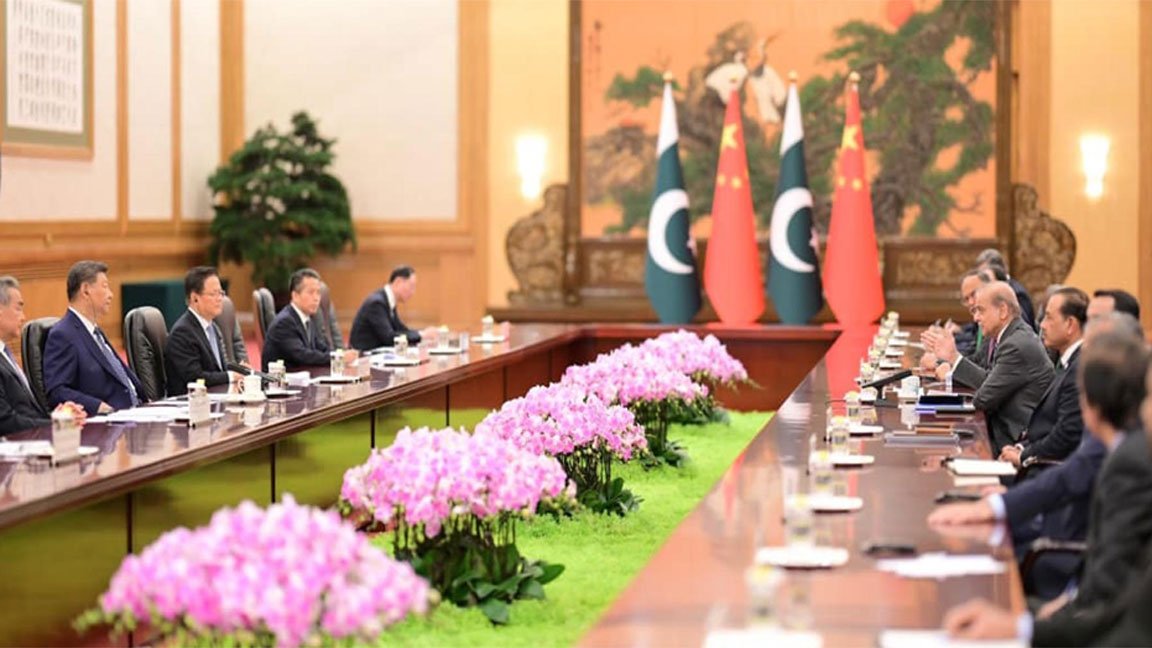

Prime Minister Shehbaz Sharif and Chinese Premier Li Qiang reaffirmed their commitment to advancing the second phase of the China-Pakistan Economic Corridor (CPEC), a meeting the Pakistani premier described as “warm and most productive.”
The discussions, held during Shehbaz’s six-day visit to China, focused on expanding cooperation across multiple sectors, including infrastructure, agriculture, information technology, and industry.
According to the Press Information Department, both sides agreed to accelerate the implementation of CPEC 2.0, particularly its five new corridors. PM Shehbaz highlighted the importance of early progress on major projects such as the ML-1 railway upgrade, the Karakoram Highway realignment, and the operationalisation of Gwadar Port. He also encouraged Chinese companies to expand their investment footprint in Pakistan, identifying IT, textiles, minerals, and agriculture as priority areas.
The meeting followed earlier talks between PM Shehbaz and President Xi Jinping at the Shanghai Cooperation Organisation summit, where both leaders underscored the “iron-clad, all-weather” strategic partnership between the two nations.
During the Beijing talks, a series of Memorandums of Understanding (MoUs) and agreements were signed, including the Joint Action Plan 2024–2029, viewed as a major step forward in the partnership.
PM Shehbaz expressed gratitude for China’s continued support of Pakistan’s economic stability, including a $3.4 billion loan rollover earlier this year.
He also announced Pakistan’s intent to issue Panda Bonds in the Chinese market. Both leaders celebrated the success of the Pakistan-China Business-to-Business Investment Conference, which drew hundreds of companies from both nations, highlighting opportunities for collaboration.
As both countries prepare to mark the 75th anniversary of their diplomatic ties next year, PM Shehbaz reiterated Pakistan’s full support for President Xi’s global initiatives. The discussions reinforced the shared vision of strengthening bilateral ties through CPEC 2.0, making it a cornerstone of future cooperation.
