


Regional Power Dynamics
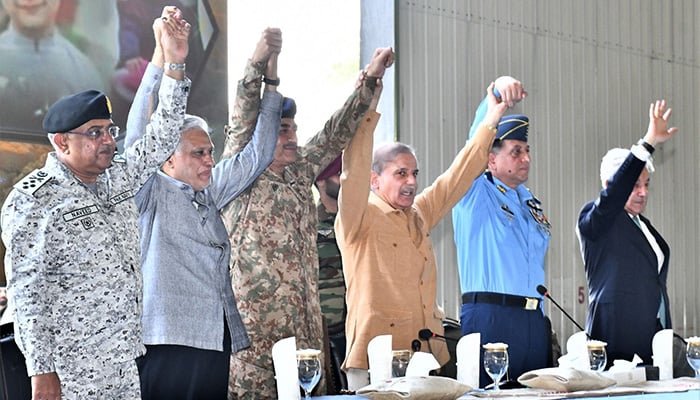
On Thursday, Prime Minister Shehbaz Sharif declared that Pakistan had decisively dismantled the illusion of India’s military supremacy in the region, asserting that New Delhi’s multibillion-dollar defense acquisitions failed to translate into strategic dominance. His remarks came during a high-level visit to the Pakistan Air Force’s (PAF) operational base in Kamra, where he was briefed on the PAF’s recent combat achievements and operational readiness.
Accompanied by top civil and military leadership — including Deputy Prime Minister and Foreign Minister Ishaq Dar, Defence Minister Khawaja Asif, Planning Minister Ahsan Iqbal, Information Minister Attaullah Tarar, Chief of Army Staff (COAS) General Syed Asim Munir, and Chief of the Naval Staff Admiral Naveed Ashraf — PM Shehbaz was received by the Chief of the Air Staff, Air Chief Marshal Zaheer Ahmed Baber Sidhu.
The visit followed a period of heightened military confrontation between India and Pakistan, ignited by India’s unprovoked air and missile strikes on Pakistani territory, resulting in the martyrdom of at least 31 civilians in Pakistan and Azad Jammu and Kashmir (AJK) on May 7.
In response, Pakistan launched “Operation Bunyan-um-Marsoos,” during which its Armed Forces demonstrated remarkable restraint, operational precision, and strategic acumen. Speaking at Kamra, the prime minister praised the PAF’s effectiveness in neutralizing enemy threats, highlighting the confirmed downing of a sixth Indian aircraft — a Mirage-2000 — near Pampore on the night of May 6–7 as a clear testament to Pakistan’s superior air combat capabilities.
“The Armed Forces delivered a calculated and forceful response that dismantled hostile military infrastructure,” PM Shehbaz stated, emphasizing that Pakistan’s sovereignty and territorial integrity are non-negotiable. “India will no longer remain trapped in arrogance. Pakistan responded with thought, deliberation, and unshakable resolve.”
He commended the leadership of Air Chief Marshal Zaheer for integrating advanced technologies into PAF operations and hailed the professionalism of the airmen, pilots, and engineers for their dedication and courage.
ISPR confirmed that Pakistan struck 26 Indian military and terror-linked targets using precision-guided long-range Fatah missiles and advanced air-launched munitions. These included facilities used to launch attacks on Pakistan and installations linked to India’s covert support for terrorism inside Pakistan.
The prime minister reaffirmed that the nation stood united behind its Armed Forces, who remain ever-ready to defend every inch of the country. “Pakistan’s defenders have proven that any act of belligerence will be met with a resolute and decisive response,” he stated.
As tensions simmered, a US-brokered ceasefire, initially announced by President Donald Trump, brought the four-day escalation to a halt. Deputy PM Ishaq Dar later confirmed that the ceasefire had been extended until May 18, offering a brief pause in what had become the most dangerous military standoff in the region in recent years.
