

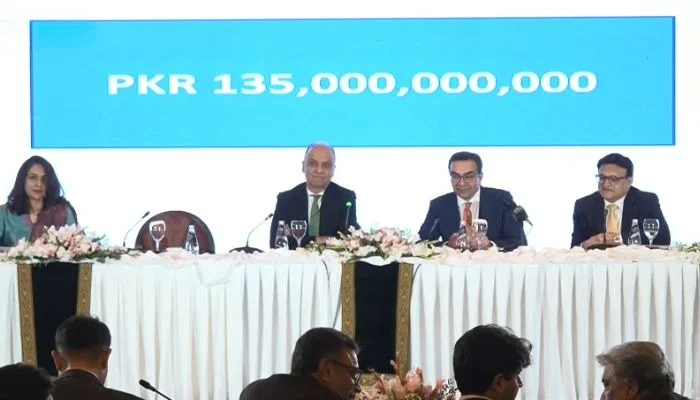

Pakistan’s long-awaited privatisation of Pakistan International Airlines (PIA) reached a major milestone as the Arif Habib Corporation Limited–led consortium emerged as the highest bidder. The consortium offered Rs135 billion to acquire a majority stake in the national flag carrier. The winning bid followed an intense and closely watched open-bidding process held in Islamabad.
The privatisation marks Pakistan’s second televised attempt to sell PIA after a failed effort last year. This time, the process attracted strong interest from leading domestic business groups. The government described the outcome as a positive signal for investor confidence and economic reform.
Competitive Bidding Pushes Offers Beyond Reference Price
The bidding process unfolded in two rounds. In the first round, sealed bids were opened publicly by a Privatisation Commission official. The event was broadcast live on state television. Three bidders participated in the race.
The Arif Habib-led consortium initially submitted a bid of Rs115 billion. Meanwhile, the Lucky Cement Limited–led consortium offered Rs101.5 billion. Both bids exceeded the government’s reference price of Rs100 billion, triggering a second round of open bidding.
During the second round, competition intensified. The Lucky Cement consortium raised its offer to Rs134 billion. In response, Arif Habib Corporation increased its bid to Rs135 billion, securing the top position.
The Lucky Cement-led group included Hub Power Holdings Limited, Kohat Cement Company Limited, and Metro Ventures. The Arif Habib consortium comprised Fatima Fertiliser Company Limited, City Schools, and Lake City Holdings Limited. A third bidder, private airline Air Blue (Private) Ltd, also participated but did not submit the highest offer.
Government Calls Privatisation a Win for Pakistan
Finance Minister Muhammad Aurangzeb addressed the ceremony and welcomed the outcome. He said the success of the bidding process ultimately belonged to Pakistan. He highlighted that all participating bidders were Pakistani companies.
According to the finance minister, this was a major and encouraging development. He said leading domestic business groups competing for the national airline reflected growing confidence in the economy. The airline, he noted, would now be led by experienced Pakistani investors.
Aurangzeb added that the transparent process would help attract foreign investment indirectly. Strong local participation sends a positive signal to global investors. He also emphasized that the government wants state-owned enterprises to become financially independent.
The finance minister congratulated Adviser to the Prime Minister on Privatisation Muhammad Ali and his team. The process was described as professional and credible.
Sale Structure, Investment Plan, and Employee Protection
Before the bidding, Muhammad Ali explained the government’s strategy. He clarified that the aim was not merely to sell PIA. The objective is to revive the airline and restore its past glory.
The government decided to sell 75% of PIA’s shares. Some bidders had shown interest in full ownership. Ultimately, the structure was designed to allow flexibility. Of the total bid amount, 92.5% will be invested directly into PIA. The remaining 7.5% will go to the government.
Payment will be made in phases. Two-thirds of the amount must be paid within 90 days. The remaining one-third can be paid within 12 months. Bidders are also allowed to include up to two additional partners after the process concludes.
The government has assured 12 months of job security for PIA employees. Pension liabilities and post-retirement benefits will be handled by a holding company. Salaries and current benefits will be paid by the new owners.
Improved Outlook Strengthens PIA’s Valuation
PIA’s prospects have improved significantly since last year. The government has assumed most of the airline’s legacy debt. PIA has reported its first pre-tax profit in two decades. A five-year ban imposed by the UK and the European Union has also been lifted.
The airline now holds landing rights for 78 destinations and around 170 international slots. Analysts believe reopening key routes will boost revenues. The privatisation is part of a broader reform agenda under Pakistan’s IMF bailout program.
The sale of PIA is expected to reduce fiscal pressure and strengthen investor confidence. Further privatisations of state-owned entities are also planned.
