

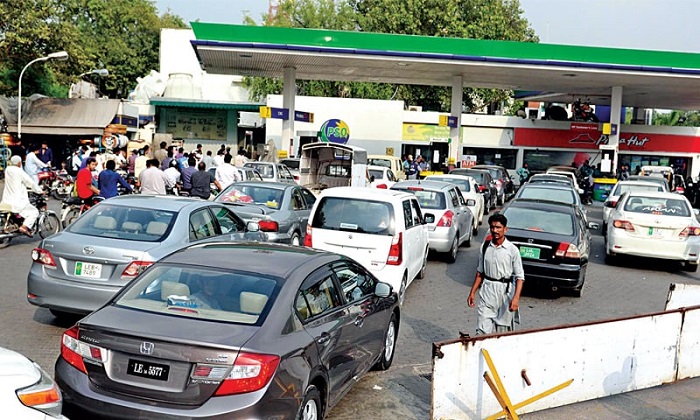

ISLAMABAD: The prices of petrol and high-speed diesel (HSD) are anticipated to rise by Rs1-4 per litre on Thursday (February 29) for the upcoming fortnight. This adjustment is attributed to slight fluctuations in international prices, import premiums, and the exchange rate.
Over the past fortnight, both major petroleum products, petrol, and HSD, experienced marginal movements, ranging from 10 to 50 cents per barrel, in the international market. This necessitated higher import premiums for petrol, as indicated by the Pakistan State Oil (PSO).
The estimated increase places the price of petrol Rs3-4 higher per litre compared to HSD, which is expected to see a rise of Rs1-1.5 per litre, contingent upon the final exchange rate calculation. On February 28, the US dollar depreciated by approximately 15 paise against the rupee. Conversely, the prices of kerosene and light diesel oil are anticipated to remain stable.
For pricing calculations, officials noted a rise of about $0.5 per barrel for petrol, reaching $90.78 from $89.20 per barrel over the last two weeks. Conversely, HSD experienced a slight decrease of about eight cents per barrel, falling to $101.05 from approximately $101.13.
During this period, the rupee maintained general stability. Import premiums paid by PSO for petrol increased slightly to $10.45 per barrel for this fortnight from $9.47 per barrel, remaining unchanged for HSD at $6.5 per barrel.
The government has already reached the maximum permissible limit of Rs60 per litre for the petroleum levy on both petrol and HSD, as mandated by law. The budget target for petroleum levy collection during the current fiscal year, set at Rs869 billion, has seen significant progress with around Rs475 billion collected in the first half (July-December) of the fiscal year.
Despite gradual increases in the per-litre levy, the government is aiming to collect approximately Rs970 billion by year-end, with a revised target of Rs920 billion by end-June.
The high inflation rate recorded in January, at 27.5%, has been primarily influenced by the prices of petroleum and electricity, as indicated by the consumer price index. Petrol, primarily used in private transport, small vehicles, and two-wheelers, directly impacts the budgets of the middle- and lower-middle class.
Conversely, HSD, predominantly utilized in heavy transport vehicles, trains, and agricultural engines, contributes significantly to inflation, particularly affecting the prices of essential commodities like vegetables.
Currently, the government imposes a tax of approximately Rs82 per litre on both petrol and HSD, with zero general sales tax (GST) on all petroleum products. Additionally, a petroleum development levy (PDL) of Rs60 per litre is levied on both products, alongside a charge of Rs50 per litre on high octane blending component and 95RON petrol. Customs duty of about Rs17-20 per litre is also imposed on petrol and HSD.
With monthly sales of approximately 700,000 to 800,000 tonnes, petrol and HSD serve as significant revenue generators compared to the relatively low demand of around 10,000 tonnes per month for kerosene.
