


By: S. Zeeshan A Shah
As the Holy Month of Ramadan has started, the country is observing a peaceful season of prayer. However, in several areas, uncertainty has taken hold as thousands of people living near the Afghan border have chosen to flee and seek refuge from the threat of imminent conflict.
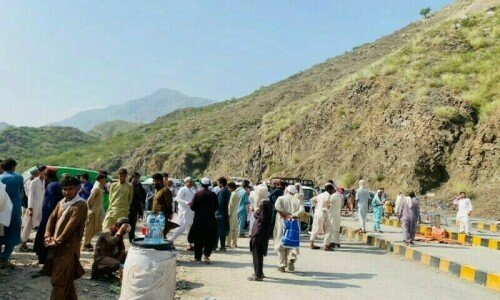
Following Pakistan’s military operations against the Afghan Taliban, hundreds of thousands of residents have reportedly lost their homes after relocation to safer zones. Large-scale displacement has been reported from the Tirah Valley, a rugged mountainous region in Khyber Pakhtunkhwa that borders Afghanistan, as tensions and fighting intensify in the surrounding areas. Meanwhile, the government’s messaging remains inconsistent. Local officials claim the central government issued orders to evacuate residents, while federal authorities have rejected these claims.
Estimates suggest that between 60,000 and 80,000 people from the Tirah Valley have been displaced and now remain without stable homes or livelihoods. During one of the harshest winter seasons, many endured freezing temperatures and severe cold spells while attempting to escape the border region. Government representatives have dismissed the situation, describing it as “seasonal migration” and nothing more.
Yet fear persists among affected families, many of whom face financial hardship and a sense of abandonment within their own country. They remain doubtful about receiving compensation for lost homes and livelihoods, without which returning will be nearly impossible. As a result, despair is growing, with many residents feeling ignored by their own state.
All attention now rests on the nation’s Armed Forces to rescue these communities from displacement by ensuring security, safeguarding housing, and protecting families. Many displaced residents have reportedly traveled nearly 100 miles to Bara Town, near Peshawar, in search of temporary shelter.
The crisis traces back to the Taliban’s return to power in Afghanistan, which triggered a renewed wave of militancy on both sides of the border. On Pakistan’s side, rising attacks by Afghan-linked rebels pushed the Pakistan Army to strengthen defenses and respond with precision. The area around Tirah Valley became part of the conflict zone. The presence of TTP (Tehrik-e-Taliban Pakistan) was identified as a major threat, raising fears of a full-scale confrontation between armed forces and militant groups.
According to the Pakistan Institute of Peace Studies, an independent research organization, Pakistan has witnessed more than 700 attacks, resulting in over 1,000 casualties, including a recent mosque attack near Islamabad that killed more than 30 people. Furthermore, Pakistan expelled over 900,000 Afghans last year and carried out additional airstrikes inside Afghanistan, including in Kabul.
This new wave of displacement arrives at a challenging moment for Pakistan, as the region remains strained by political maneuvering, tensions along the Iranian border, volatile relations between India and Pakistan, and a slowdown in Pak-China engagement. With increasing American pressure on Pakistan to assist under the Gaza Peace Deal under President Trump, the government faces an exceptionally difficult period.
Pakistan’s political landscape is divided. One side advocates peace talks with Afghanistan, arguing that repeated conflict has failed to improve relations or eliminate the TTP and the broader Taliban movement. The other side insists that local leadership and the military must present a united front to prevent Taliban rebels from infiltrating Pakistani borders.
The 37th UNSC report also highlighted the presence of terrorist groups in Afghanistan as a serious concern for the region. This further supports Islamabad’s position that Afghanistan has become a sanctuary for militants using its territory to launch attacks on Pakistan during a sensitive time.
A major challenge now lies in building effective coordination between the federal government in Islamabad and the provincial government led by Pakistan’s main opposition party. Overall, the country continues to face economic strain and social polarization, with structural reforms needed across all four provinces and a consistent strategic direction required to achieve good governance and create employment for over 30 million Pakistanis within the next decade.
Ultimately, it remains to be seen whether these unfolding patriot games will deliver victory for Pakistan or become a national tragedy.
About the Writer: The writer is a former Director @SHCC (Sindh Healthcare Commission) and Director CNNA (Children Nature Network Asia), an advocacy initiative, and an expert on government affairs, media relations, IR, and governance. A thought leader, change maker, and a renowned author and media broadcaster.
