


By Col. Chaudhry Muhammad Sabahuddin IS Retired
Exclusive Analytical Article
Abstract
Rare earth elements (REEs) have emerged as strategic enablers of 21st-century technologies, underpinning renewable energy, advanced electronics, and defense systems. While China dominates the global extraction and refining industry, the United States is seeking to diversify supply chains through partnerships with alternative producers. Pakistan, endowed with significant yet untapped mineral reserves, holds the potential to emerge as a credible stakeholder in this evolving resource domain. However, weak institutional frameworks, technological deficits, and security challenges have prevented meaningful progress. This paper examines global REE competition, contrasts Chinese and American capabilities, and evaluates Pakistan’s resource endowment, challenges, and strategic opportunities.
Introduction
Control of critical resources has historically shaped global power dynamics: oil defined the 20th century, and rare earth elements (REEs) increasingly define the 21st. Comprising 17 chemically similar minerals, REEs are essential to technologies ranging from renewable energy and electric vehicles to semiconductors, satellites, and precision-guided weaponry. Global demand has surged, and with it, the geopolitical contest over access, processing, and supply chain security.
China has established near-monopoly control over extraction and refining, while the United States—though technologically advanced—remains dependent on Chinese supply chains. In this competitive landscape, Pakistan possesses geological potential valued at trillions of dollars, yet remains on the margins due to structural, political, and security barriers. This article analyzes the global REE contest, assesses Pakistan’s position, and outlines pathways for strategic integration into international supply chains.
China’s Command of the REE Industry
China dominates the global rare earth Elements (REE) sector, holding reserves of 44 million tons and accounting for nearly 85% of worldwide production, processing, and supply. This dominance has made even major economies—most notably the United States, which imports 80% of its REEs from China—heavily dependent on Beijing for critical inputs vital to high-tech and defense industries worth trillions of dollars. Although the U.S. has initiated efforts to develop domestic capacity, including Pentagon-funded exploration projects, reducing reliance on China will take years. Meanwhile, global demand for REE is projected to rise from 140,000 tons in 2019 to 220,000 tons by 2025 at a 7% annual growth rate, driven primarily by Asia-Pacific economies. While cerium and lanthanum are currently the most consumed, future demand will increasingly center on neodymium, dysprosium, and terbium—essential for electric vehicles, renewable energy systems, and other advanced technologies—further reinforcing the strategic importance of REE in the emerging global economy.
China accounts for approximately 70 percent of global REE extraction and more than 85 percent of refining capacity. Its dominance rests on three pillars:
- Vertical Integration – complete control from mining to refining to downstream manufacturing.
- Overseas Acquisition Strategy – securing concessions in Africa, Latin America, and Central Asia.
- Technological Investment – advancing refining, recycling, and exploring thorium as a potential nuclear fuel.
Beijing has demonstrated its readiness to leverage this dominance as a geopolitical tool. During disputes with Japan and the United States, China restricted REE exports, signaling the potential to weaponize supply control. This has raised alarm among industrialized states whose advanced sectors depend heavily on steady access to these minerals.
U.S. Capabilities and Vulnerabilities
The United States retains strong geological endowment but suffers from dependence on Chinese refining capacity. The Mountain Pass mine in California, once the world’s largest producer, has resumed operations under MP Materials, yet most ore is still shipped to China for processing.
American vulnerabilities are threefold:
- Limited refining capacity – separation and processing technologies remain underdeveloped.
- Environmental and cost pressures – high compliance costs have historically deterred domestic refining.
- Strategic dependency – industries critical to defense and innovation remain reliant on imports from China.
Efforts to reverse this dependence include federal investment in recycling technologies, strategic partnerships with Australia and Canada, and attempts to re-establish domestic refining capacity. Nonetheless, China’s entrenched position makes decoupling a long-term rather than immediate prospect.
Pakistan’s Geological Endowment
Pakistan is estimated to possess mineral reserves exceeding $50 trillion, with rare earth reserves alone potentially worth $6 trillion. Surveys conducted by the Geological Survey of Pakistan (GSP) and the Pakistan Atomic Energy Commission (PAEC) have highlighted significant occurrences in:
- Chagai (Balochistan): granitic and pegmatite complexes rich in thorium and uranium.
- Dir, Swat, Kohistan (Khyber Pakhtunkhwa): REE-bearing granites and metamorphic complexes.
- Sindh and Balochistan coastal sands: potential monazite deposits, akin to those in India and Sri Lanka.
- Himalayan and Hindukush belts: igneous and metamorphic formations linked to monazite, xenotime, and bastnäsite.
Despite this endowment, Pakistan remains absent from the global REE supply chain. Weak regulation, lack of refining capacity, political instability, and security risks—particularly in Balochistan—have constrained development. Following are the 17 elements
Table: Key Rare Earth Elements and Their Industrial Uses
| Element | Primary Industrial Uses |
| Neodymium (Nd) | Permanent magnets in electric vehicle motors, wind turbines, headphones, and hard drives |
| Dysprosium (Dy) | High-temperature magnets for EVs and wind turbines; essential in military-grade systems |
| Europium (Eu) | Red phosphors in LED lighting, televisions, and display panels |
| Terbium (Tb) | Green phosphors in displays; fuel cells; stabilizers for high-strength magnets |
| Lanthanum (La) | Camera lenses, optical glass, battery electrodes (nickel–metal hydride batteries) |
| Cerium (Ce) | Catalytic converters in automobiles, glass polishing agents, and alloys |
| Yttrium (Y) | Superconductors, lasers, medical imaging devices, and ceramics |
| Samarium (Sm) | High-strength permanent magnets; nuclear reactor control rods |
| Gadolinium (Gd) | MRI contrast agents; neutron capture in nuclear reactors |
| Erbium (Er) | Fiber-optic communication systems; lasers for medical and industrial applications
|
These applications illustrate why REEs are not merely raw materials but strategic assets that determine competitiveness in defense, innovation, and green technologies.
Washington’s Renewed Interest in Pakistan
Pakistan’s mineral wealth is beginning to attract foreign interest. During Army Chief Field Marshal Asim Munir’s visit to Washington in June 2025, discussions reportedly included rare earth exploration and cooperation. While no formal agreements were signed, diplomatic sources indicate preliminary frameworks were considered:
- Joint exploration with U.S. companies.
- Establishing refining and separation capacity within Pakistan.
- Integrating Pakistan into U.S.-aligned supply chains to reduce dependence on China.
Such cooperation could mark a shift in Pakistan–U.S. relations, broadening them from a traditional security focus to a strategic economic partnership. For Washington, this aligns with efforts to diversify REE sources. For Islamabad, it presents opportunities for investment, technology transfer, and renewed strategic leverage.
Projected Global REE Demand Growth (2019–2025)
- Line graph showing increase from 140,000 tons (2019) to 220,000 tons (2025) at ~7% CAGR.
- Highlight growing demand for neodymium, dysprosium, terbium (essential for EVs and renewables).
China vs. U.S. REE Supply Chain Control
- Infographic or flow diagram:
- China → Mining → Refining → Manufacturing.
- S. → Mining (Mountain Pass) → China (processing) → Manufacturing (U.S./Allies).
Pakistan’s Geological REE Endowment
- REE deposits are at following places :
- Chagai (Balochistan) → thorium, uranium.
- Dir, Swat, Kohistan (KP) → REE granites.
- Sindh & Balochistan coasts → monazite sands.
- Himalayan/Hindukush belts → xenotime, bastnäsite.
Global REE Major Reserves and Annual Production (million tons)
| Country | Reserves (M tons) | Production (M tons/year) | Share of Global Refining (%) |
| China | 44 | 0.10 | ~85% |
| Brazil | 22 | 0.001 | <1% |
| Russia | 12 | 0.03 | <5% |
| India | 6.9 | 0.002 | <2% |
| Australia | 3.4 | 0.02 | ~10% |
| USA | 1.4 | 0.02 | <5% |
| Pakistan* | ~6 (est.) | negligible | 0% |
Barriers to Realization
Pakistan’s entry into the REE sector is constrained by:
- Regulatory weakness: outdated mining laws, corruption, and opaque licensing.
- Technological deficits: absence of domestic refining and processing capacity.
- Security environment: insurgent activity in Balochistan threatens mining projects.
- Geopolitical balancing: close integration with China through CPEC complicates deeper alignment with U.S. supply chains.
- Pakistan’s total mines and mineral reserves are estimated at over $50 trillion in situ value in 2019, including metallic, fuel, industrial minerals, gemstones, building stones, clays and other resources. Exports of mineral fuels, oils and distillation products accounted for $500 million in 2018. In the recent past, the government lived in a fallacy after failure of copper-gold projects in Saindak and Reko Diq. Authorities made bets throughout the lease timeframe to eventually fold in a showdown by handing over national assets to foreign entities.
- The key explanations for these failures included:
- Inadequate legal and institutional framework (eg, absence of a comprehensive policy and governance structure)
- Limited institutional capacity (eg, regulatory and monitoring body at the national level)
- Sub-optimal research and development facilities (eg, no dedicated research institute)
- Low availability of resources (eg, lack of skilled workforce, latest tools and technology)
- Lack of necessary infrastructure (eg, electricity, roads, water)
- High security risk (given remote locations of mines)
Pakistan’s Barriers to Entry
| Barrier | Impact on Sector Development | Example (Case) |
| Weak regulation | Opaque licensing, corruption | Reko Diq delay |
| Lack of refining tech | Reliance on foreign processing | Saindak copper |
| Security risks | Disruption in Balochistan | Attacks on mines |
| Infrastructure deficit | No electricity/water/roads | Remote mine sites |
Unless these barriers are addressed, Pakistan risks perpetuating the cycle of low-value exports and strategic irrelevance.
From Resource Pawn to Potential Kingmaker
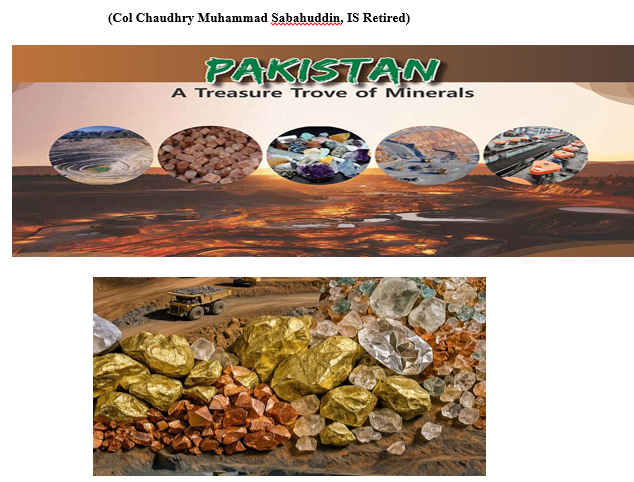
Pakistan sits atop immense mineral wealth: copper and gold in the Tethyan Belt of Balochistan, lithium in Gilgit-Baltistan, and rare earth elements critical for semiconductors and defense. Yet, inconsistent policies, weak infrastructure, and security concerns have long hampered development. Recent reforms—such as resolving the Reko Diq dispute—signal Islamabad’s willingness to engage global investors.
For Washington, this is more than economics. China already dominates Pakistan’s infrastructure through CPEC and is securing mining contracts, while its thorium research promises to reshape global energy. The U.S., reliant on Chinese rare earths, urgently needs cost-effective alternatives. Pakistan offers both resources and strategic location. But American engagement will be transactional resources in exchange for capital, technology, and jobs.
Pakistan now has leverage. It can demand better royalty structures, technology transfer, and workforce participation. Yet it must also ensure regulatory stability, learning from past failures. Rather than relying on outdated geopolitics, Islamabad should present itself as an economic partner. In an era where resources define power, Pakistan has the chance to shift from bystander to stakeholder—if it acts decisively before the window closes.
Policy Implications for Pakistan
To unlock its potential, Pakistan must adopt a multi-pronged strategy:
- Modernize mining governance – transparent, investor-friendly policies to attract foreign capital.
- Develop refining and processing capacity – establish joint ventures with advanced economies to move beyond raw extraction.
- Invest in human capital and research – build a skilled workforce and support universities in mineral sciences.
- Secure mineral-rich regions – integrate development and security strategies to stabilize Balochistan.
- Balance great power competition – leverage U.S. interest without undermining relations with China
Such steps would allow Pakistan not only to monetize its reserves but also to position itself as a credible player in a sector shaping future geopolitics.
Conclusion
The contest over rare earth elements reflect a profound shift in global power politics. China has already established dominance, while the United States is struggling to rebuild lost capacity. Pakistan, though endowed with vast reserves, risks remaining a passive bystander unless it pursues bold reforms and strategic partnerships. The opportunity, however, is unprecedented: by modernizing governance, developing refining capacity, and carefully balancing its relations with both Washington and Beijing, Pakistan can transform its geological wealth into sustainable economic and strategic capital. If Islamabad acts decisively, it will not only secure a stronger position in the global REE supply chain but also redefine itself as a strategic partner in shaping the future of 21st-century resource geopolitics.
About the Author

Muhammad Sabahuddin Chaudhry
Senior Security & Fire Life Safety Consultant | Pakistan
Muhammad Sabahuddin Chaudhry is a highly respected Senior Security and Fire Life Safety Consultant with over 40 years of extensive professional experience across the defence, banking, and corporate sectors. His distinguished career includes 11 years in senior management roles at Citi Bank, where he specialized in security management, investigation, crisis response, human resources, and administrative operations.
An MBA-qualified professional, who also served as Country Manager – Human Resources at Wackenhut, a Pathfinder Group company in Pakistan, for two years. In this role, he led a broad portfolio that included Human Resource Management and Development, risk mitigation, protocol management, training, facility operations, and strategic coordination with law enforcement agencies.
He began his career in the Pakistan Armed Forces (Aviation) and has consistently demonstrated a deep commitment to operational excellence and national service. In recognition of his outstanding contributions, he was awarded the prestigious Imtiazi Sanad (National Gallantry Award) by the President of Pakistan, along with two commendation cards from the Chief of Army Staff.
