

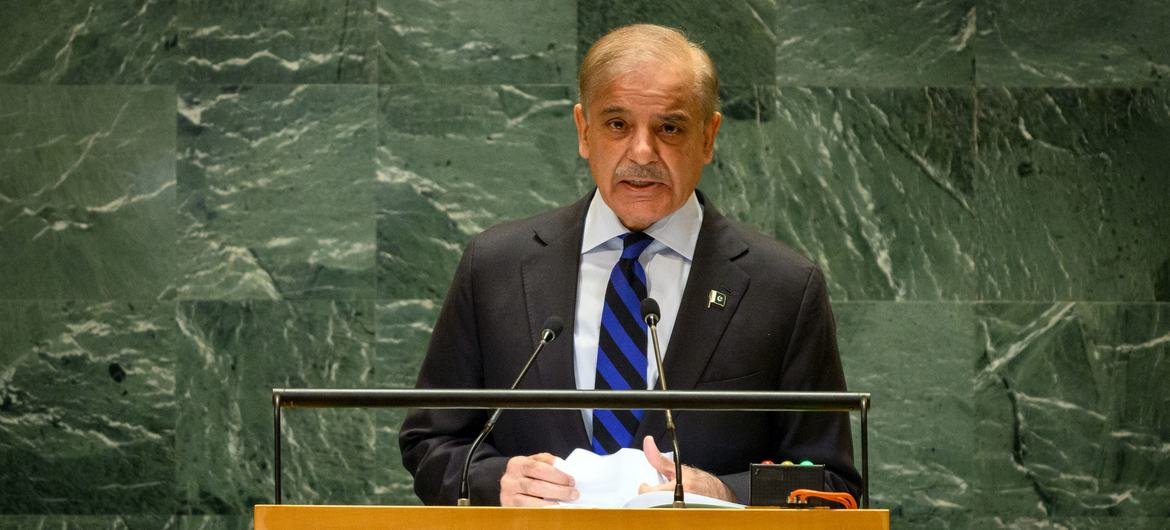

Prime Minister Shehbaz Sharif addressed the 80th session of the United Nations General Assembly in New York, where he outlined Pakistan’s stance on pressing global and regional challenges.
He emphasized that the world is witnessing intensifying conflicts, violations of international law, rising humanitarian crises, the persistence of terrorism, the spread of disinformation, and the existential threat posed by climate change — issues that demand collective global responses.
Sharif underlined that multilateralism is not optional but essential. He reiterated Pakistan’s foreign policy, rooted in peace, dialogue, and diplomacy, as envisioned by Quaid-i-Azam. Turning to regional security, the prime minister recalled his earlier warning about Pakistan’s readiness to respond decisively to external aggression.
He stated that this warning materialized in May when Pakistan confronted unprovoked attacks from India, repelling them with “stunning professionalism and bravery.” He praised the armed forces, particularly under Field Marshal Asim Munir and the air force leadership, for their historic response that downed seven Indian jets.
Sharif also highlighted the role of Pakistan’s unity, lauding the courage of martyrs and their families. He noted that although Pakistan emerged from the conflict in a position of strength, it accepted a ceasefire facilitated by U.S. President Donald Trump’s intervention, which he credited with averting a larger war. Pakistan has since nominated Trump for the Nobel Peace Prize, describing him as a “man of peace.”
Looking forward, Sharif extended an offer of comprehensive dialogue with India, stressing that South Asia needs “proactive rather than provocative” leadership.
He warned against India’s unilateral moves regarding the Indus Waters Treaty, stressing that Pakistan considers any violation of this treaty as an act of war, and reaffirmed the country’s determination to defend its water rights and territorial integrity.
