

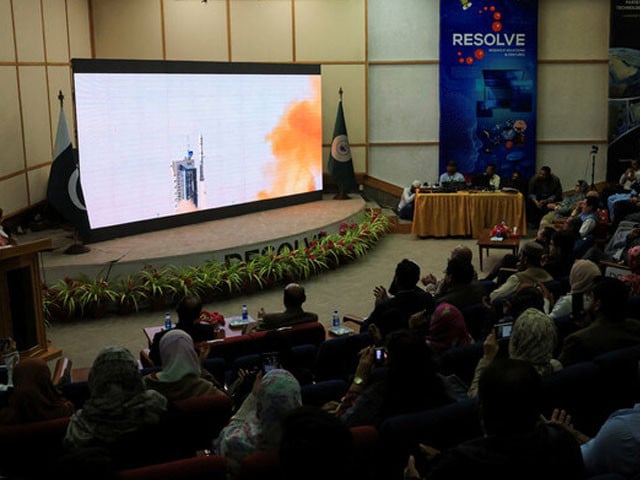

Collaboration with China to explore the lunar south pole and pave the way for future space exploration
ISLAMABAD: Pakistan has taken a significant step forward in its deep space exploration ambitions with the signing of a historic Memorandum of Understanding (MoU) between the Space and Upper Atmosphere Research Commission (Suparco) and the China National Space Administration (CNSA), as announced in an official statement on Thursday.
The agreement, signed on February 5th, 2025, in the presence of President Asif Ali Zardari of Pakistan and President Xi Jinping of China, officially confirms Pakistan’s participation in China’s Chang’e-8 mission, which is scheduled for launch in 2028.
Pakistan’s Lunar Rover on the Chang’e-8 Mission
The Chang’e-8 mission, led by CNSA, is designed to conduct autonomous scientific exploration, technology verification, lunar surface mapping, and resource utilization on the moon. As part of this mission, Pakistan will deploy its first indigenous lunar rover to the moon’s south pole, a region of great scientific interest due to its unique environment and potential for future human exploration.
This collaboration represents a major milestone for Pakistan’s space program and its contribution to the International Lunar Research Station (ILRS) initiative.
Pakistan’s Indigenous Lunar Rover
Suparco’s lunar rover, which has been independently designed, manufactured, and tested by Pakistani scientists and engineers, will carry advanced scientific payloads developed by Suparco, as well as an international scientific payload created through collaboration between Chinese and European scientists. This combination of efforts will allow for comprehensive lunar surface analysis, further boosting the mission’s capabilities.
Once deployed, Pakistan’s rover will be operated and controlled by scientists from Pakistan, showcasing the country’s growing expertise in space technology and its increasing role in lunar exploration.
Scientific and Technological Goals
The lunar rover will contribute to several key scientific and technological objectives, including:
- Analyzing the lunar soil composition to assess its potential for resource utilization.
- Mapping the lunar surface to support future exploration missions.
- Studying emissions and plasma properties on the lunar surface to understand their potential effects on future exploration and human presence.
- Testing new technologies essential for sustainable lunar operations and long-term human presence.
This partnership between Suparco and CNSA reflects the strong bilateral ties between Pakistan and China and their shared commitment to advancing deep space exploration. It also highlights Pakistan’s dedication to expanding its space program and contributing to global scientific research.
By participating in this historic mission, Pakistan is firmly establishing itself as an emerging player in space exploration, with a focus on scientific discovery and technological innovation.
