

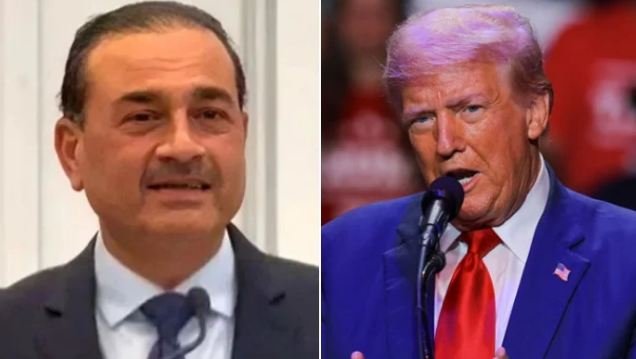

Pakistan’s recent diplomatic maneuvers with the administration of U.S. President Donald Trump have triggered strong reactions from India, according to a detailed report by the Financial Times (FT). The report, compiled by correspondents stationed in Islamabad, New Delhi, and Washington, highlights a notable “unexpected resurgence” in U.S.-Pakistan relations—a shift that has caught regional observers and Indian officials by surprise.
One of the most prominent developments underscoring this shift is the increased engagement between senior Pakistani officials and key figures in the U.S. political and military landscape. Chief of Army Staff General Asim Munir has made two high-profile visits to the United States this summer alone. His latest visit included attending the retirement ceremony of General Michael Kurilla, the head of U.S. Central Command, in Florida. More notably, Gen Munir reportedly held a private two-hour lunch meeting with President Trump in June. This meeting took place shortly after a significant military confrontation between Pakistan and India, raising eyebrows in diplomatic circles given Trump’s previously critical stance on Pakistan.
A Multi-Faceted Diplomatic Approach
The FT attributes Pakistan’s diplomatic gains to a calculated and multi-dimensional strategy. Senior Pakistani officials have reportedly combined traditional counterterrorism cooperation with modern outreach methods—engaging Trump’s business allies and exploring new economic ventures in areas such as energy, mineral resources, and cryptocurrency.
A crucial moment in this renewed relationship came in March, when Pakistan arrested and transferred to U.S. custody an ISIS-K suspect believed to be responsible for orchestrating the 2021 Kabul airport bombing. Trump praised this development in his State of the Union address, giving rare public acknowledgment to Pakistan’s cooperation.
Additionally, the FT highlights an April agreement between World Liberty Financial—a cryptocurrency initiative reportedly backed by Trump—and Pakistan’s Crypto Council. During a visit to Pakistan, one of the venture’s co-founders expressed strong interest in the country’s vast untapped mineral wealth, suggesting the economic relationship may deepen further.
India’s Reaction and Rising Regional Tensions
India has reportedly responded with “deep irritation” to the growing ties between Islamabad and Washington. This irritation was further inflamed by a recent U.S. decision to increase tariffs on Indian exports to 50 percent, while keeping Pakistan’s rate comparatively lower at 19 percent. Furthermore, Prime Minister Narendra Modi rejected Trump’s claim that the U.S. had helped mediate a ceasefire in May between India and Pakistan, asserting instead that the agreement had been achieved independently through direct military dialogue.
Analysts suggest that Pakistan’s adept handling of diplomacy under Trump, particularly in light of the former president’s unconventional leadership style, has contributed to the warming relationship. Michael Kugelman, a senior fellow at the Asia Pacific Foundation, told FT, “I would describe the relationship now as one that’s enjoying an unexpected resurgence, even a renaissance. Pakistan has very successfully understood how to engage with such an unconventional president.”
As Pakistan continues to diversify its diplomatic and economic ties, and India pushes back against perceived U.S. favoritism, the region may face renewed tension and recalibration of alliances.
