

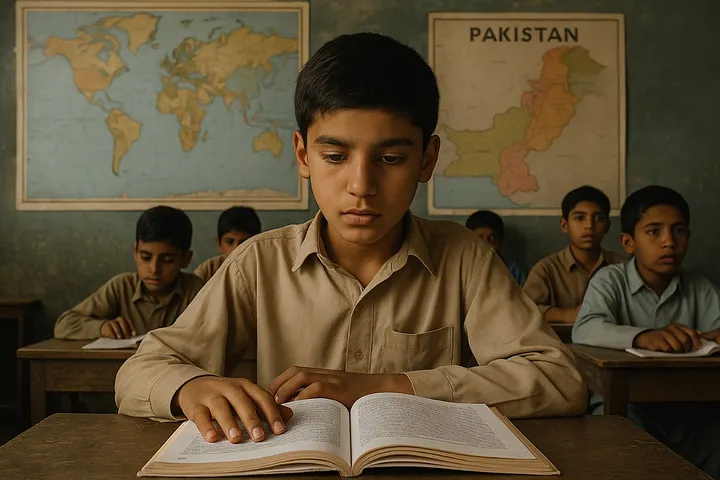

The Pakistani curriculum is designed to provide students with essential knowledge, moral values, and practical skills. It is implemented in public and private schools across the country, aiming to create responsible citizens who can contribute to national development.
The curriculum is developed at the federal level and ensures that students across Pakistan learn core subjects such as Mathematics, Science, English, Urdu, Social Studies, and Islamic Studies from early grades.
Structure of the Pakistani Curriculum
The Pakistani curriculum is divided into different levels:
-
Primary Education (Grade 1-5)
Focuses on building basic learning skills like reading, writing, counting, and understanding simple concepts. Subjects at this stage are kept simple to create a strong foundation. -
Middle Education (Grade 6-8)
Students are introduced to more detailed concepts in science, mathematics, and language. The curriculum encourages critical thinking and analytical skills. -
Secondary Education (Grade 9-10)
Students prepare for the Matriculation exams, choosing between Science and Arts groups. This level shapes future academic choices. -
Higher Secondary Education (Grade 11-12)
Students choose specialized fields such as Pre-Medical, Pre-Engineering, Commerce, Humanities, or Computer Science. The chosen field influences future university programs and careers.
Key Features of the Pakistani Curriculum
-
National Identity and Cultural Values
It promotes respect for cultural diversity, Islamic teachings, and national pride. -
Balanced Academic Focus
Subjects are taught in a way that balances theoretical knowledge with practical learning. -
Uniformity Across Regions
The curriculum is standardized, ensuring students in different provinces receive similar education. -
Character and Personality Development
Emphasis is placed on discipline, ethics, social responsibility, and respect for others.
Challenges in the Pakistani Curriculum
Despite improvements, certain challenges still exist:
-
Traditional teaching methods are used more than modern interactive techniques.
-
Lack of trained teachers in some regions affects learning quality.
-
Technology integration in classrooms is still limited.
Recent Improvements
In recent years, curriculum frameworks have been updated to:
-
Introduce activity-based learning.
-
Improve English and communication skills.
-
Add modern subjects like IT and digital literacy.
-
Focus on critical and creative thinking.
Why the Pakistani Curriculum is Important
The Pakistani curriculum plays a key role in shaping the future of students by:
-
Guiding them towards success in higher education.
-
Strengthening their understanding of society and culture.
-
Preparing them to join the workforce confidently.
FAQs
Q1: What is taught in the Pakistani curriculum at the primary level?
Primary students learn basic reading, writing, mathematics, Urdu, English, Islamic Studies, and general science.
Q2: Who designs and updates the Pakistani curriculum?
The curriculum is prepared and periodically reviewed at the federal level to maintain national standards.
Q3: Is the Pakistani curriculum the same in all provinces?
Yes, the core subjects are uniform across the country, but provinces may include their own additional material.
Q4: What is the main focus of the Pakistani curriculum?
It focuses on academic learning, moral education, cultural values, and national identity.
