

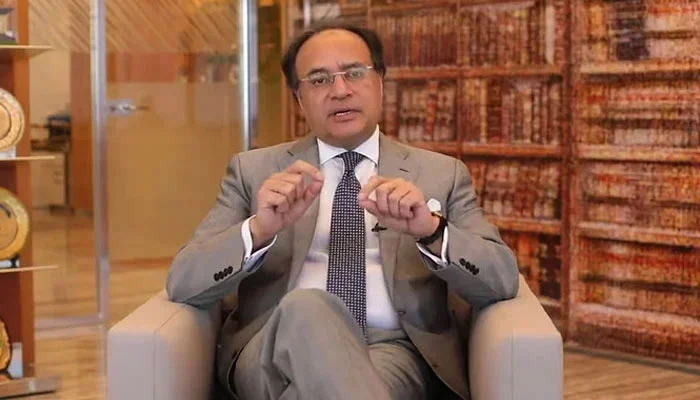

ISLAMABAD: Finance Minister Muhammad Aurangzeb announced on the government’s intention to engage with the International Monetary Fund (IMF) for a substantial and extended program under the Extended Fund Facility (EFF).
In his inaugural media briefing since assuming office, the newly appointed minister outlined his strategy for economic stabilization.
Acknowledging the significant challenge of rising prices impacting the general populace, the minister emphasized that achieving macroeconomic stability would gradually alleviate this burden.
He noted with optimism that Consumer Price Index (CPI)-based inflation had begun to show signs of receding.
Aurangzeb hinted at a potential reduction in the policy rate, while emphasizing that decisions regarding the Monetary Policy Committee (MPC) fall within the purview of the autonomous State Bank of Pakistan (SBP).
Regarding the post-EFF agreement with the IMF, he disclosed plans to attract foreign inflows through commercial financing and the issuance of international bonds.
Highlighting the importance of the Special Investment Facilitation platform, Aurangzeb underscored its role in attracting equity and investment from overseas.
He emphasized the need to transition from relying solely on securing deposits and rollover from friendly partners to presenting viable and bankable projects for investment.
Aurangzeb stated that all available options, including exploring climate financing and increasing the size of allocated quota under the EFF program, would be considered during upcoming negotiations with the IMF review mission.
Addressing the trust deficit with the IMF, he expressed confidence in meeting the Fund’s stipulations and requested the completion of the second review under the SBA program.
Additionally, Aurangzeb revealed plans to initiate discussions for a new EFF program in the forthcoming talks.
He emphasized the urgency of addressing structural bottlenecks, focusing on plugging leakages, digitizing processes within the Federal Board of Revenue (FBR), and addressing issues within State-Owned Enterprises (SOEs).
Aurangzeb outlined plans to broaden the tax net to include wholesalers, retailers, real estate, and agriculture income.
The IMF review mission is scheduled to visit Islamabad from March 14 to 18, 2024, to conduct the second review and release the last tranche of $1.1 billion under the Standby Arrangement (SBA) program.
Aurangzeb stressed the need to move from policy discussions to implementation to address economic challenges effectively.
Accompanied by Federal Secretary Finance Imdad Bosal and DG Media Finance Ministry, Aurangzeb clarified his role, holding both the portfolios of finance and revenues.
He emphasized that structural benchmarks from previous IMF programs would guide reform efforts, positioning the reform plan as Pakistan’s agenda.
Aurangzeb warned against continued patchwork solutions, advocating for sustained reforms to steer the economy out of its current predicament.
He underscored the importance of boosting the tax-to-GDP ratio and pursuing privatization to enable the private sector to assume a leading role in driving economic growth.
