

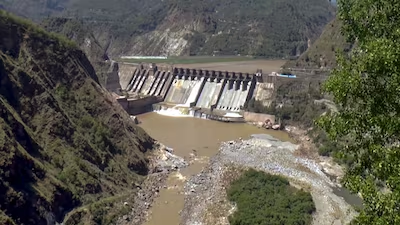

Indus Waters Treaty
Pakistan is preparing to launch international legal action in response to India’s recent unilateral suspension of the Indus Waters Treaty, a critical river water-sharing agreement between the two nations. The move comes amid escalating tensions following a deadly attack on tourists in Indian-administered Kashmir — an incident India has blamed on Pakistan, a claim Islamabad strongly denies.
Speaking to Reuters, Pakistan’s Minister of State for Law and Justice, Barrister Aqeel Malik, confirmed that Islamabad is finalizing a comprehensive legal strategy to challenge India’s decision. “Legal strategy consultations are almost complete,” Malik said, adding that Pakistan is exploring at least three legal avenues to address what it considers a breach of international commitments by India.
One of the primary steps under consideration is approaching the World Bank, which acts as the facilitator of the 1960 Indus Waters Treaty. Malik also revealed that Pakistan is examining the possibility of taking the matter to the Permanent Court of Arbitration (PCA) and the International Court of Justice (ICJ) in The Hague. He indicated that a case could be built around the violation of the Vienna Convention on the Law of Treaties, which governs the creation and operation of international agreements.
India last week announced the suspension of the Indus Waters Treaty, citing Pakistan’s alleged support for cross-border terrorism as the justification. The announcement followed the killing of 26 people in an attack in Kashmir. India claims that two of the three suspected attackers were of Pakistani origin. Pakistan has firmly denied any involvement, calling the accusation baseless.
In a strong warning, Pakistan has stated that any attempt by India to alter or halt the flow of water to Pakistan would be considered an “act of war.” In response to the treaty suspension, Pakistan has also cut off trade with India and closed its airspace to Indian airlines.
The Indus Waters Treaty, signed in 1960 and mediated by the World Bank, allocates the waters of the Indus River and its tributaries between the two countries. The river system sustains nearly 80% of Pakistan’s irrigated agriculture and powers several hydropower projects, making it a vital resource for the country’s economy and food security. Remarkably, the treaty has survived multiple wars and decades of hostilities between India and Pakistan, underscoring its significance.
According to Malik, a fourth diplomatic route under review includes raising the issue at the United Nations Security Council (UNSC). “All the options are on the table and we are pursuing all appropriate and competent forums to approach,” he emphasized. He also reiterated that India cannot legally suspend the treaty unilaterally, noting, “There is no provision within the treaty that allows for such a suspension.”
Meanwhile, Kushvinder Vohra, a recently retired head of India’s Central Water Commission, commented that India has strong legal grounds for its actions, and that Pakistan’s options for recourse may be limited. Nonetheless, international observers will be watching closely as the dispute moves from a bilateral standoff to potential global forums.
