
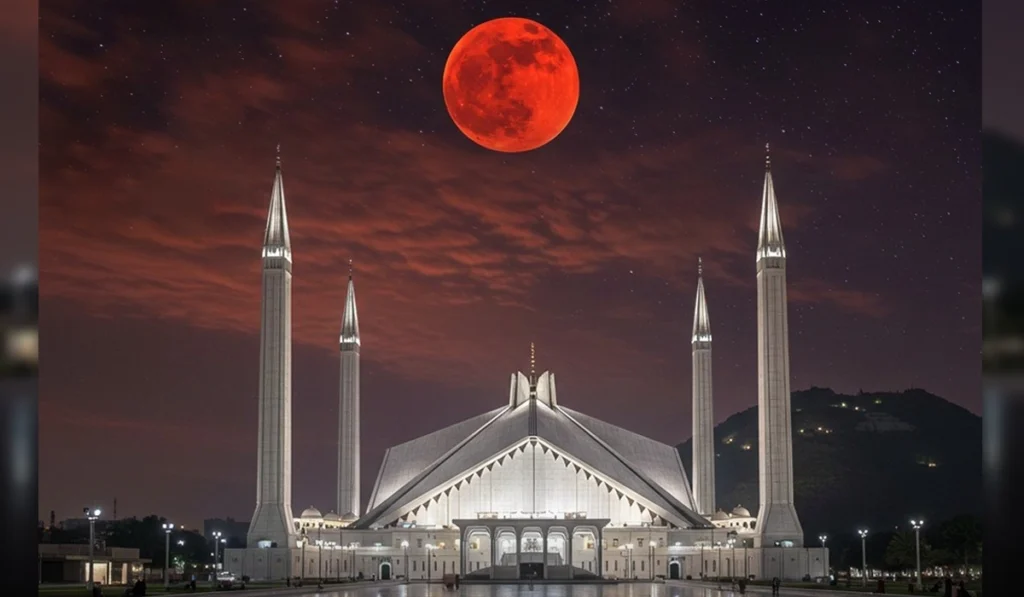

Pakistan is ready for an exciting total lunar eclipse today, March 3, 2026. The full Moon turns a vivid reddish-orange color, creating the popular Blood Moon. However, the Pakistan Meteorological Department warns that daylight covers most of the event. As a result, viewing stays limited for many people across the country.
What Causes This Striking Red Color?
It is simple science: a total lunar eclipse occurs when Earth aligns exactly between the Sun and a full Moon. During this alignment, Earth’s shadow falls across the Moon’s surface. Sunlight then filters through our atmosphere. Blue light scatters away quickly, while red and orange wavelengths bend toward the Moon. As a result, the Moon glows in deep copper tones. Many skywatchers love this natural spectacle because it is both dramatic and rare.
Key Timings You Should Know
The eclipse begins with the penumbral phase at 1:44 pm Pakistan Standard Time. At this point, the Moon enters Earth’s faint outer shadow and dims slightly. After that, the partial eclipse begins at 2:50 pm. Totality arrives at 4:05 pm, when Earth’s full shadow covers the entire Moon. The peak occurs at 4:34 pm, showing the brightest red hue. Later, totality ends by 5:03 pm. Finally, the eclipse concludes at 7:23 pm.
Because daylight dominates most stages, direct observation proves difficult in Pakistan. Still, some cities might catch the later phases after moonrise this evening. Therefore, check your local moonrise time and weather forecast carefully.
Where Else Can People See It?
Globally, eastern Asia and Australia enjoy the full eclipse during evening hours. Meanwhile, the Pacific region views it overnight. In addition, parts of North America, Central America, and western South America see it before sunrise. On the other hand, central Asia and much of South America only get a partial view. Unfortunately, Africa and Europe miss the event completely.
Easy and Safe Viewing Tips
The good news is that lunar eclipses are safe to look at without any special equipment. Furthermore, if you use binoculars or a small telescope, you can see more detailed information about the craters. For the best experience, try to find a dark location away from the city lights. As long as the skies are clear tonight, this is a great opportunity to enjoy a natural spectacle.

