


ISLAMABAD: Pakistan has signed a multi-billion-dollar agreement to sell conventional military equipment to Libya, marking a major milestone in the country’s defence export ambitions. The deal exceeds $4 billion and positions Pakistan among a group of nations that export a broad range of conventional arms and military equipment.
Officials said the agreement involves sales to the Libyan National Army (LNA) and ranks as one of Pakistan’s biggest weapons exports by both volume and value. Moreover, the deal reflects Islamabad’s growing focus on defence manufacturing as a pillar of economic growth.
Deal finalised after high-level meeting in Benghazi
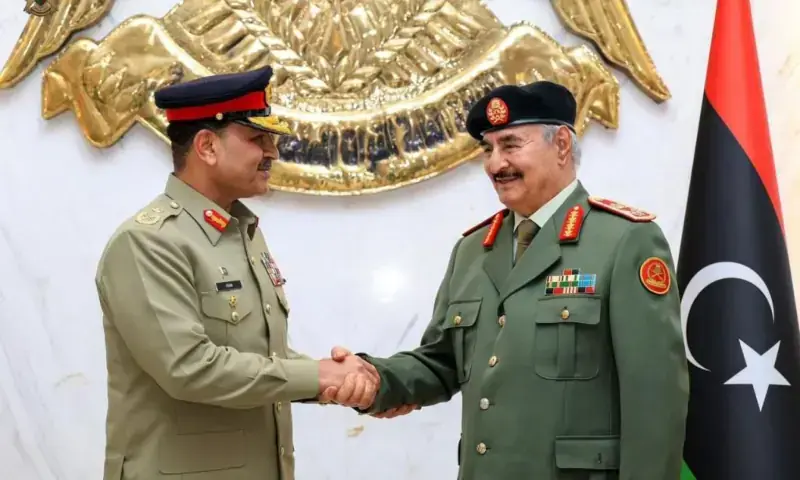
The agreement was finalised following a meeting last week in Benghazi between Chief of Defence Forces Field Marshal Syed Asim Munir and Saddam Khalifa Haftar, the deputy commander-in-chief of the LNA. Although Pakistan’s foreign ministry, defence ministry and military did not respond to Reuters’ requests for comment, senior military officials described the transaction as historic in scale and financial impact.
A copy of the draft agreement seen by Reuters listed the purchase of several JF-17 fighter jets, jointly developed by Pakistan and China, along with Super Mushak trainer aircraft used for basic pilot training. In addition, a Pakistani official confirmed that the deal covers equipment for land, sea and air forces and will be implemented over approximately two and a half years.
UN embargo raises questions but officials defend move
Since 2011, Libya has remained under a United Nations arms embargo, which requires UN approval for any transfer of weapons or related material. However, senior Pakistani military officials defended the sale, arguing that several Western and Middle Eastern countries have supplied arms to Libya for years despite the restrictions.
They described the embargo as largely ineffective and said the agreement aligns with the prime minister and army chief’s vision of building an export-driven, self-sustaining economy. Consequently, officials believe the deal supports national economic and strategic objectives.Libya remains divided amid ongoing instability
Libya continues to face deep political divisions. The internationally recognised Government of National Unity, led by Prime Minister Abdulhamid Dbeibah, controls much of western Libya. In contrast, the LNA, led by Khalifa Haftar, controls the east and south, including key oilfields, and does not recognise the unity government.
Defence cooperation extends beyond arms sales
The LNA’s official media channel reported that the two sides have entered a broader defence cooperation pact covering weapons sales, joint training and military manufacturing. “We announce the launch of a new phase of strategic military cooperation with Pakistan,” Haftar said in remarks broadcast by Al-Hadath television.
Meanwhile, Pakistan continues to expand its defence exports, drawing on decades of counterinsurgency experience and a growing domestic industry that produces aircraft, armoured vehicles, munitions and naval vessels.
