

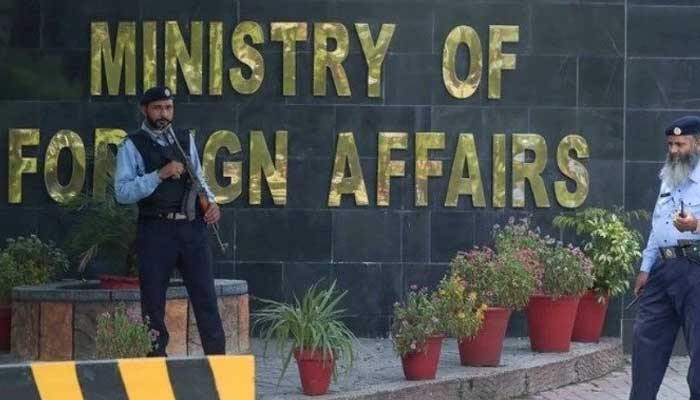

KARACHI: Pakistan’s Ministry of Foreign Affairs (FO) has strongly condemned recent comments made by former U.S. National Security Adviser John Bolton and Indian Defence Minister Rajnath Singh regarding the security of Pakistan’s nuclear arsenal, labeling the remarks as hypocritical, politically motivated, and reflective of bias.
Responding to media queries on Thursday, the Foreign Office spokesperson asserted that Pakistan remains fully confident in the safety and integrity of its nuclear command and control systems, as well as its comprehensive nuclear security regime.
The statement was issued after Bolton, during an interview with India’s ANI news agency, reiterated long-standing U.S. “concerns” over the security of Pakistan’s nuclear capabilities. Reflecting on his time in the George W. Bush administration, Bolton recalled accompanying then-Secretary of State Colin Powell to South Asia post-9/11, during which Powell raised nuclear security concerns with then-Pakistani President Pervez Musharraf.
Bolton warned that the “risk of nuclear weapons falling into the hands of terrorists or being misused by rogue commanders” remains troubling.
Bolton’s remarks came shortly after Indian Defence Minister Rajnath Singh, during a visit to Indian Illegally Occupied Jammu and Kashmir, questioned Pakistan’s status as a responsible nuclear power and called on the International Atomic Energy Agency (IAEA) to intervene. He described Pakistan as a “rogue and irresponsible nation.”
Pakistan Rejects Remarks as “Ironic” and Dangerous
In its rebuttal, the Foreign Office described Singh’s statement as “deeply ironic”, particularly given his affiliation with a Hindu extremist organization that has “consistently issued threats of aggression against Pakistan.”
“It is telling that John Bolton’s remarks were triggered by a statement from Rajnath Singh — a leader known for his extreme views, hostility toward Pakistan, and public threats,” the FO said.
The FO further criticized India’s nuclear record, stating that global concerns should be more focused on New Delhi’s arsenal, which is in the hands of individuals “driven by religious intolerance and expansionist ambitions.”
Rising Concerns Over India’s Nuclear Security
The statement noted that increasing radicalization within India’s political class, media, and segments of society poses serious concerns about the safe stewardship of nuclear weapons. It also cited recurring incidents of nuclear material theft and illegal trafficking in India as evidence of a deficient nuclear security framework.
“The existence of a nuclear black market in India is no longer speculation — it is a documented concern that should alarm the international community,” the spokesperson added.
Jaishankar Reignites Accusations Against Pakistan
Separately, Indian External Affairs Minister S. Jaishankar, speaking in the Netherlands, accused Pakistan of sponsoring cross-border terrorism. He dismissed recent claims by former U.S. President Donald Trump that Washington brokered the current ceasefire between the two South Asian neighbors.
Without providing evidence, Jaishankar urged Pakistan to stop “pretending” it is not involved in attacks on Indian soil — a charge Islamabad has repeatedly denied and termed baseless.
Pakistan’s Foreign Office reiterated its commitment to nuclear safety and security, while calling on the international community to adopt a balanced and evidence-based approach when addressing nuclear concerns in South Asia.
