

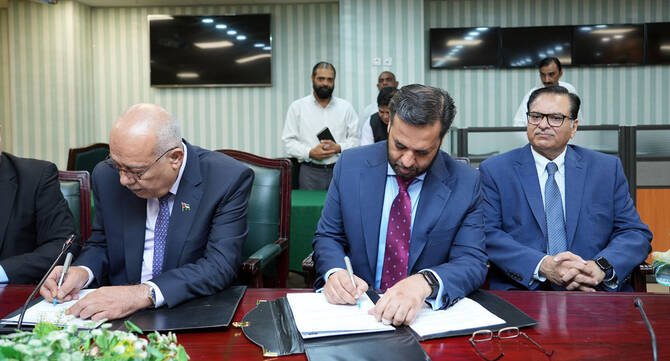

Pakistan and Palestine have taken a significant step toward strengthening bilateral cooperation in the healthcare sector by signing a Memorandum of Understanding (MoU) in Islamabad. The agreement was signed on Wednesday by Federal Minister for Health, Syed Mustafa Kamal, representing Pakistan, and the Palestinian Ambassador, who signed on behalf of his government.
According to the Ministry of National Health Services, the MoU is aimed at expanding collaboration in advanced medical fields, joint research, and professional training opportunities. It is expected to create a long-term framework for strengthening healthcare systems in both countries through the exchange of knowledge and expertise.
Minister Kamal announced that a Pakistan–Palestine Health Working Group will be established within the next 30 days to supervise the implementation of the agreement and ensure the smooth execution of its initiatives.
The areas of cooperation identified in the MoU cover a wide spectrum of medical specialties including interventional cardiology, organ transplants, orthopedic surgery, burn treatment, plastic surgery, and endoscopic ultrasound. Pakistan has also pledged to provide support in infectious diseases, ophthalmology, pharmaceuticals, and collaborative medical research.
Training opportunities for Palestinian doctors and medical staff at Pakistan’s leading institutions are a key feature of the agreement. “The purpose of this agreement is to foster closer collaboration for improving the health and well-being of the people of both brotherly nations,” Kamal said, reiterating Pakistan’s commitment to stand with Palestine not only politically and morally but also in humanitarian and medical spheres.
The Palestinian Ambassador welcomed the initiative, expressing deep gratitude to Pakistan for its continuous support. He emphasized that the agreement was not merely symbolic but a practical roadmap for strengthening health systems and improving patient care.
The MoU highlights Pakistan’s consistent stance of solidarity with Palestine, extending it into public health collaboration, and reaffirming the shared vision of both nations to work together for the welfare of their peoples.
