

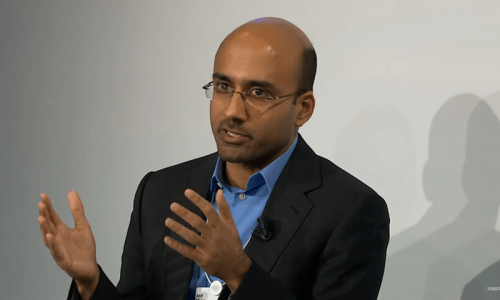

Pakistan can still unlock significant economic potential if it commits to consistent, disciplined reforms, economist Atif Mian argued in a recent blog. He outlined a “Five-for-Fifty” model in which Pakistan would aim to grow its per capita income by 5% annually for the next 50 years.
According to Mian, countries with similar starting points—such as China and South Korea—managed to achieve global average income decades earlier by maintaining strong and uninterrupted early growth.
In contrast, Pakistan’s long-term performance tells a different story. While the country recorded per capita growth of about 3% during the 1980s, this momentum has eroded over time, falling to near-zero levels in recent years. As a result, the gap between Pakistan’s income levels and the global average has widened sharply.
Mian argues that Pakistan is stuck in a persistent stagnation regime. Even when growth accelerates briefly, it quickly collapses due to weak institutions and inconsistent policy direction. He says this cycle has repeated under every political leadership because decisions are often made without analytical depth, credibility, or institutional continuity.
He also highlights several structural deficiencies: excessive taxes on electricity that burden industry and households; confusion between short-term foreign borrowing and genuine investment; poorly structured policy interventions such as the SIFC; chronic overvaluation of the exchange rate; and a pattern of elite-driven, low-productivity economic choices.
To break free, Mian stresses the need for modern economic governance built on reliable data, empowered technical experts, and independent research institutions. He recommends an incremental, evidence-driven reform model—similar to China’s approach—as a path toward sustained high growth.
Mian concludes that Pakistan’s next 50 years could be transformative if the state commits to long-term discipline and is willing to confront entrenched interests.
