
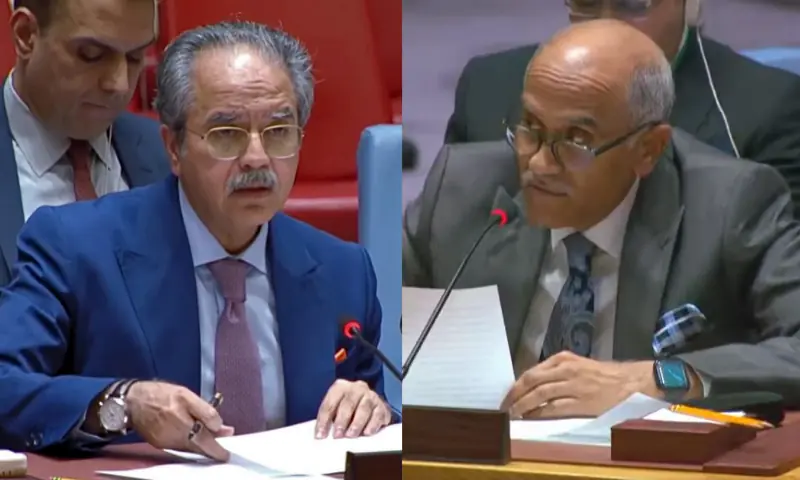

Washington: Pakistan strongly criticised India during a tense United Nations Security Council debate on Afghanistan, accusing New Delhi of hypocrisy on cross-border terrorism and complicity in militant activity affecting the region.
Pakistan’s Permanent Representative to the UN, Ambassador Asim Iftikhar Ahmad, responded sharply to remarks from Indian and Afghan representatives who had criticised Islamabad’s counterterrorism actions and cross-border strikes inside Afghanistan.
During the session, India’s envoy Parvathaneni Harish condemned cross-border airstrikes and expressed concern over civilian casualties. He described such attacks as violations of international law, the UN Charter and state sovereignty.
India also warned about what it called “trade and transit terrorism”, suggesting that vulnerabilities of landlocked developing countries should not be exploited.
However, Ambassador Ahmad rejected the accusations and said India’s remarks were expected given what he described as New Delhi’s hostility toward Pakistan. He argued that India’s Afghanistan policy aimed primarily at destabilising Pakistan.
Furthermore, Ahmad accused India of supporting militant groups operating from Afghan territory, including the Tehreek-i-Taliban Pakistan and the Baloch Liberation Army.
Pakistan disputes Afghan representative’s remarks on cross-border strikes
Meanwhile, Ahmad also criticised remarks made by Naseer Ahmad Faiq, the chargé d’affaires of Afghanistan’s UN mission, who highlighted civilian casualties linked to the Pakistan-Afghanistan conflict.
Ahmad questioned Faiq’s legitimacy and said the diplomat did not represent Afghanistan’s current authorities. He also argued that Faiq ignored the threat posed by militant groups operating from Afghan soil.
The Pakistani envoy insisted Islamabad’s operations targeted terrorist infrastructure and complied with international law and the right to self-defence.
Moreover, he said Pakistan had presented evidence of India’s alleged links with militant organisations involved in attacks inside the country.
In closing, Ahmad urged Afghanistan’s authorities to fulfil commitments on counterterrorism, inclusive governance and protection of women’s rights while warning against attempts to destabilise Pakistan.

