
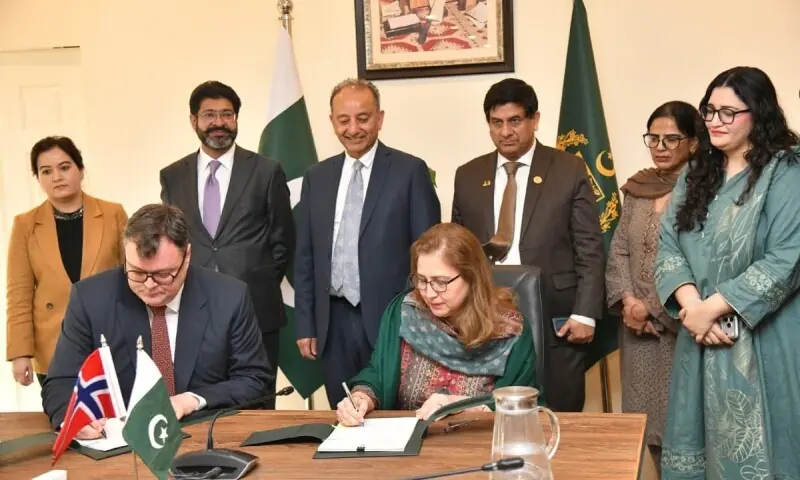

Pakistan and Norway have signed a landmark carbon market agreement under the Paris Agreement. The deal marks Pakistan’s first bilateral partnership under Article 6.2 of the global climate framework.
The agreement was signed in Islamabad under the supervision of the Ministry of Climate Change and Environmental Coordination. Officials described the move as a major step forward in Pakistan’s climate diplomacy. It opens new opportunities for carbon trading, climate finance, and green investment.
The development is being seen as a turning point. It signals Pakistan’s formal entry into the global carbon market. Experts believe the agreement could attract international funding for climate-related projects.
Carbon Market Deal Opens Doors for Green Investment
Under the agreement, Pakistan can develop projects that generate carbon credits. These projects will focus on clean energy, agriculture, transport, and waste management sectors. The country can then sell emission reductions to Norway.
This mechanism will help Pakistan earn revenue while reducing greenhouse gas emissions. It will also support sustainable development across key sectors. The deal is expected to encourage private investors and project developers.
Musadik Malik called the agreement a historic milestone. He said it moves Pakistan from planning to implementation in carbon markets. According to him, the deal creates a reliable pathway for international cooperation.
He added that carbon markets should deliver real benefits. These include job creation, technology transfer, and community development. The government aims to ensure that climate policies support economic growth.
Pakistan has already approved national guidelines for carbon trading. These were endorsed by the federal cabinet in early 2025. Authorities are now working on systems for reporting, regulation, and bilateral cooperation.
Norway Expands Global Climate Partnerships
Per Albert Ilsaas said the agreement marks a new phase in bilateral relations. He highlighted Pakistan’s vulnerability to climate change. He also stressed the importance of supporting developing countries.
Norway aims to become climate neutral by 2030. As part of this goal, it plans to purchase carbon credits known as Internationally Transferred Mitigation Outcomes (ITMOs). These credits will go beyond its formal climate commitments.
The ambassador said Norway is not only focused on small projects. It is interested in large-scale programmes across sectors. These include renewable energy, agriculture, and industry.
Norway has already signed similar agreements with several countries. These include Benin, Indonesia, Zambia, Jordan, and Senegal. The country plans to acquire up to 15 million carbon credits by 2030.
Its Global Emission Reduction Initiative, launched in 2024, has a budget of $1.5 billion. This fund will support climate projects in partner countries like Pakistan.
Future Projects and Economic Impact
The agreement could unlock major investment opportunities in Pakistan. Renewable energy projects are expected to benefit the most. Officials have identified initiatives like solar and wind energy projects as potential areas of cooperation.
The deal may also improve Pakistan’s access to climate finance. It can attract private-sector participation and international funding. This will help the country transition towards a low-carbon economy.
Both countries agreed to expand collaboration in the future. Pakistan will present a pipeline of projects to Norway for potential investment. These projects will focus on reducing emissions at scale.
The agreement strengthens Pakistan’s position in global climate efforts. It also supports its commitments under the Paris Agreement. Experts believe it will help the country balance economic growth with environmental protection.
This partnership reflects a growing trend of international cooperation. Countries are working together to tackle climate change through innovative financial tools. Pakistan’s entry into the carbon market is a significant step in this direction.

