

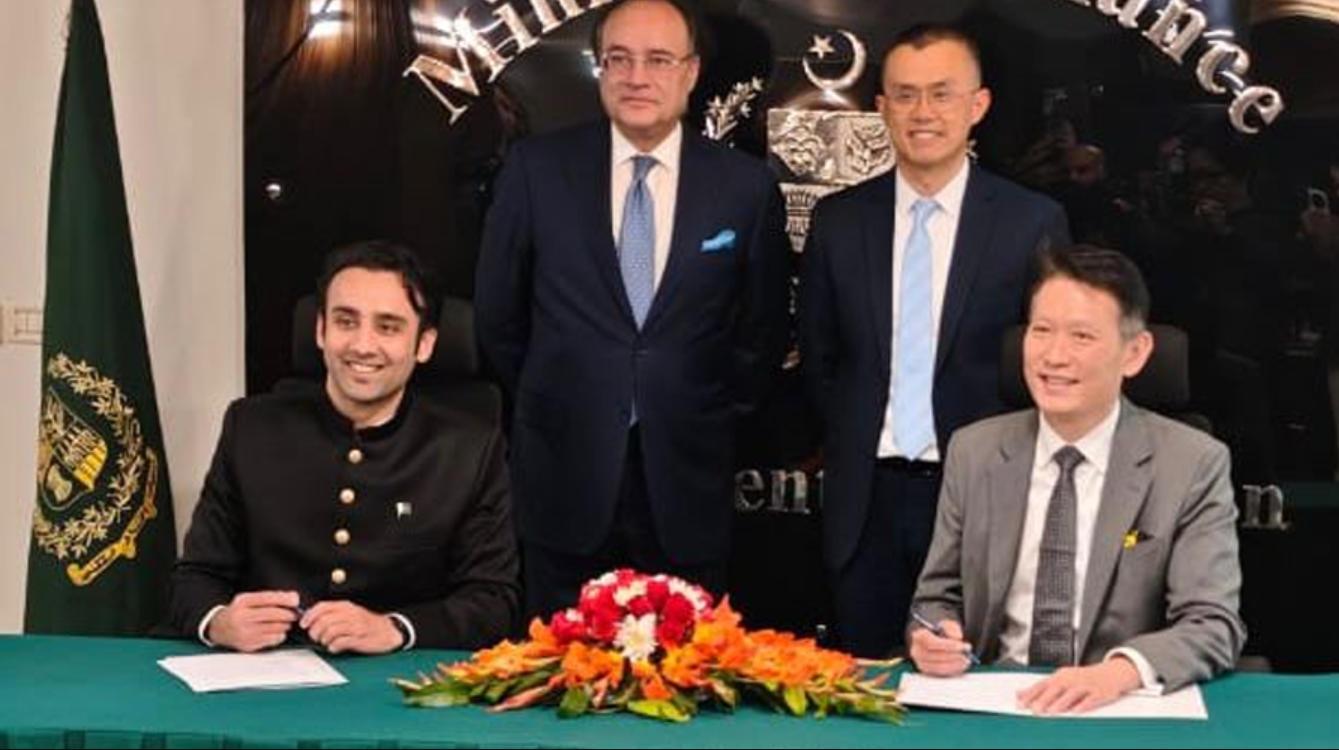

Pakistan has taken a major step toward integrating blockchain and digital assets into its financial system. The Ministry of Finance signed a Memorandum of Understanding (MoU) with Binance, one of the world’s largest blockchain firms. This agreement marks the start of a framework to explore tokenization of Pakistan’s real-world and sovereign assets.
MoU Focuses on Tokenizing Sovereign Assets
The MoU, signed in Islamabad by Finance Minister Muhammad Aurangzeb and Binance Co-CEO Richard Teng, with CEO Changpeng Zhao present, outlines potential collaboration. Tokenization could involve government bonds, treasury bills, commodity reserves, and other federally owned assets. The initiative may include assets worth up to $2 billion. The goal is to improve liquidity, transparency, and access for international investors.
Under the proposed arrangement, Binance may provide technical expertise, advisory services, training, and capacity-building support. Pakistan aims to develop secure digital platforms while retaining full sovereign control over its assets.
Finance Minister Highlights Reform Momentum
Finance Minister Aurangzeb described the MoU as a signal of Pakistan’s reform trajectory and long-term vision. He emphasized that execution would follow rapidly, supported by leadership at the highest level. Binance CEO Changpeng Zhao called the agreement a landmark step, noting its potential benefits for technology-driven youth and Pakistan’s digital economy.
Non-Binding Agreement and Future Planning
The MoU is non-binding and represents an expression of intent. Any definitive agreements will be negotiated within six months, adhering to Pakistani laws and regulatory approvals. The arrangement does not include exclusive procurement commitments.
Initial Regulatory Clearance to Binance and HTX
Separately, Pakistan has granted initial regulatory clearance to Binance and HTX to begin the licensing process. The Pakistan Virtual Assets Regulatory Authority (PVARA) issued No Objection Certificates (NOCs) after reviewing governance, compliance, and risk frameworks.
The NOCs allow platforms to register with Pakistan’s anti-money-laundering system, establish regulated local subsidiaries, and prepare full exchange license applications once regulations are finalized. PVARA stated that only fully compliant platforms will advance under a phased licensing framework aligned with global AML and counter-terror financing standards.
Government Supports Responsible Crypto Innovation
PVARA Chair Bilal bin Saqib described the NOC issuance as the beginning of a new chapter for Pakistan’s digital finance ecosystem. Finance Minister Aurangzeb emphasized that the structured framework demonstrates the government’s commitment to responsible innovation and financial discipline.
Pakistan’s Growing Digital Finance Sector
Despite the lack of formal regulation until now, Pakistan ranks as the third-largest crypto market by retail activity. The government has recently accelerated digital-finance reforms, including establishing the Pakistan Crypto Council, PVARA, and drafting a comprehensive licensing regime. Plans are also underway for a central bank digital currency pilot and the Virtual Assets Act in 2025.
Pakistan has engaged with international partners on digital-asset infrastructure and is exploring investment proposals from crypto mining and AI data centers using surplus electricity. These steps signal a clear commitment to modernizing the country’s financial sector through blockchain and digital innovation.
