

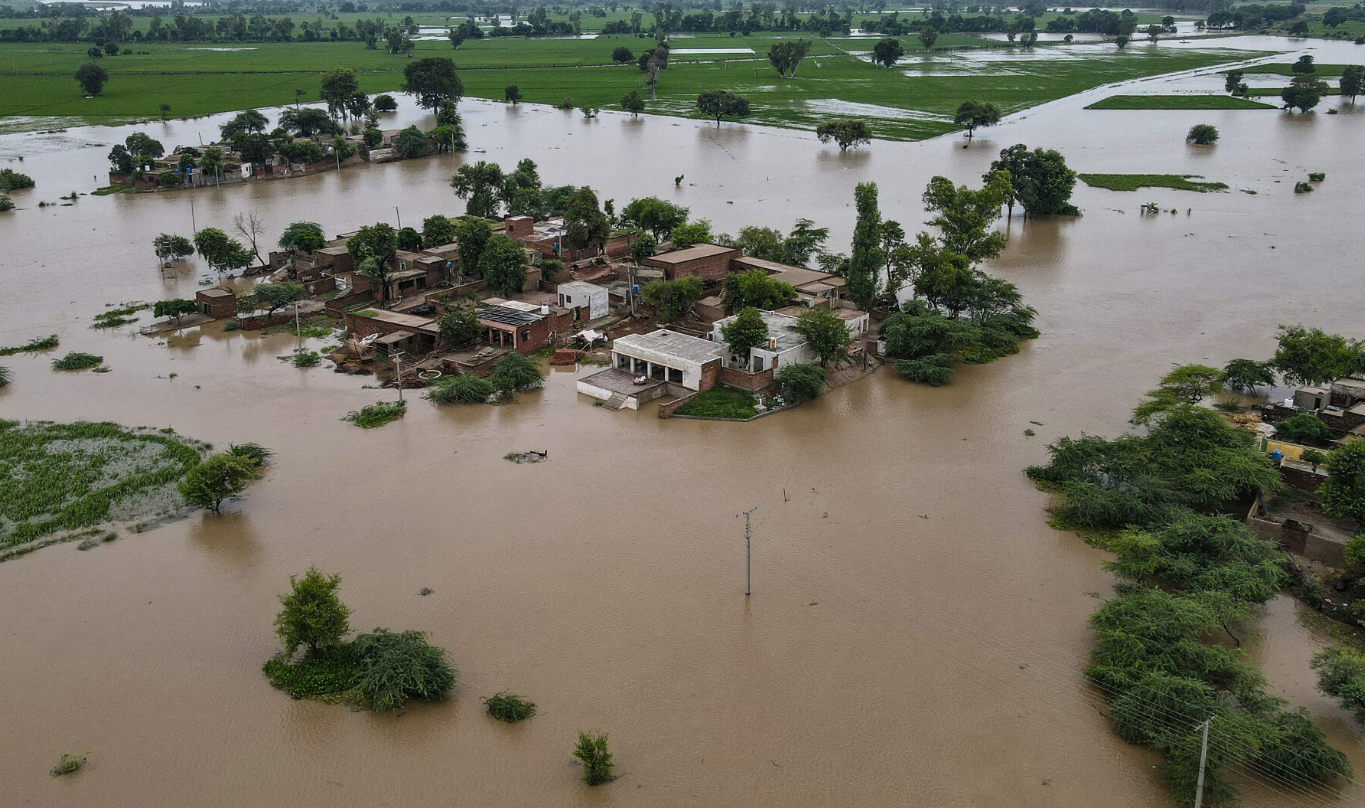

LAHORE/ISLAMABAD: More than 1.46 million people have been affected by the devastating floods as the Punjab government has launched one of the largest evacuation operations in recent history across the province. The Chenab River is expected to swell to dangerous levels at Head Trimmu, raising fears of even more destruction in the coming days.
According to official reports, extremely high floods in the Sutlej, Ravi, and Chenab rivers have already claimed 17 lives. The province is facing its worst flooding in 40 years, leaving hundreds of villages submerged and vital grain crops destroyed.
Flood Situation Worsens
Heavy monsoon rains combined with India’s release of excess dam water have triggered massive flooding in more than 1,400 villages. In several areas, authorities were forced to deliberately breach riverbanks to minimize damage, though the move displaced thousands. Officials warn that between 700,000 and 800,000 cusecs of water may pass through the Chenab River system within the next 48 hours, which could bring widespread devastation.
The large-scale relocation operation spans several districts, including Jhang, Shorkot, Multan, Muzaffargarh, Khanewal, Jalalpur Pirwala, Shujaabad, and Alipur. Over 265,000 people have already been evacuated, with many relocated to relief camps and provided with food, medical care, and temporary shelter.
Scale of Damage
The Provincial Disaster Management Authority (PDMA) reported that 1,692 mouzas have been affected. Nearly 991 villages were inundated by the Chenab alone, while 395 were hit in Sialkot, 127 in Jhang, 124 in Multan, and dozens more across other districts. Over one million people have been displaced and more than 73,000 animals rescued. Veterinary camps have been established to prevent livestock losses.
The Ravi River submerged around 80 villages, mainly in Narowal, displacing 11,000 people. Similarly, flooding in the Sutlej affected 361 villages, including Kasur, Bahawalnagar, Pakpattan, and Multan, forcing nearly 127,000 people to evacuate.
Relief and Response
Punjab Information Minister Attaullah Tarar praised the coordination between government agencies and security forces, particularly in Gujranwala and Wazirabad, where a major disaster was narrowly averted. Relief goods, including tents, food, and medicine, are being distributed, while surveys are underway to assess losses. However, the minister stressed that no compensation will be granted for illegal structures built in flood-prone areas.
The floods also disrupted flight operations at Sialkot International Airport, where services were suspended for 24 hours due to inundated runways and drainage work.
Leadership Visits and International Support
Prime Minister Shehbaz Sharif and Punjab Chief Minister Maryam Nawaz Sharif conducted aerial surveys of flood-hit regions. CM Maryam criticized India’s decision to release water from its dams, calling it a factor that worsened the crisis, though she highlighted the effectiveness of Punjab’s early warning system.
Internationally, Turkish President Recep Tayyip Erdogan called PM Shehbaz to express solidarity and offered assistance in rescue and relief efforts, reaffirming the strong brotherly ties between Pakistan and Turkiye.
