

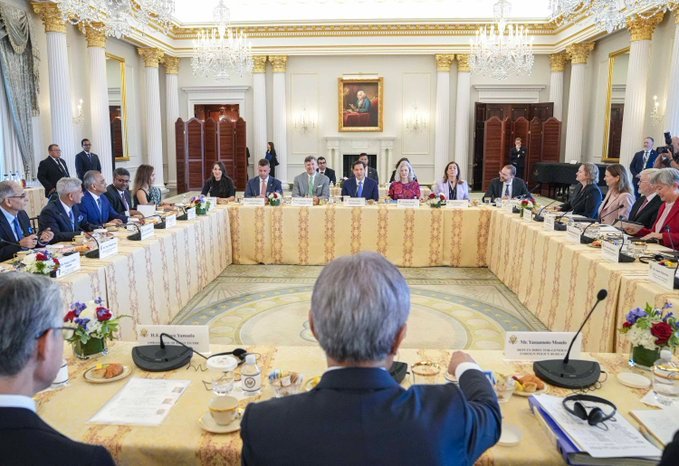

The Quad alliance—comprising the United States, India, Japan, and Australia— called for swift justice in response to the April 22 attack in Pahalgam, which claimed the lives of 26 tourists in Indian Illegally Occupied Jammu and Kashmir (IIOJK).
The assault triggered a sharp military escalation between nuclear-armed neighbors India and Pakistan, as New Delhi blamed Islamabad without presenting any concrete evidence. Pakistan strongly denied involvement and called this mishap as a false flag operation. Pakistan demanded an impartial international investigation into the incident.
In a joint statement issued by the U.S. State Department following a meeting of the four foreign ministers in Washington, the Quad condemned the violence but avoided accusing Pakistan.
“The Quad unequivocally condemns all acts of terrorism and violent extremism in all its forms and manifestations, including cross-border terrorism,” the ministers said.
They urged all United Nations member states to fully cooperate with relevant authorities to ensure that the “perpetrators, organisers, and financiers of this reprehensible act” are brought to justice without delay.
The attack and its fallout led to a major military confrontation between India and Pakistan. In response to Indian strikes, Pakistan launched “Operation Bunyan-um-Marsoos,” targeting several Indian military installations across multiple fronts.
Pakistan claimed it downed six Indian fighter jets—including three Rafale aircraft—and dozens of drones during the conflict. The hostilities, which lasted nearly 87 hours, ended on May 10 following a ceasefire agreement mediated by the United States.
