


The global stockpile of nuclear weapons is expected to rise in coming years for the first time since the Cold War due to global tensions, a leading arms watchdog has said.
In its annual report published on Monday (PDF), the Stockholm International Peace Research (SIPRI) said on Monday that all nine nuclear-armed countries are increasing or upgrading their arsenals.
“There are clear indications that the reductions that have characterised global nuclear arsenals since the end of the Cold War have ended,” said Hans Kristensen, associate senior fellow with SIPRI’s Weapons of Mass Destruction Programme and director of the Nuclear Information Project at the Federation of American Scientists, Al-Jazeera reported today.
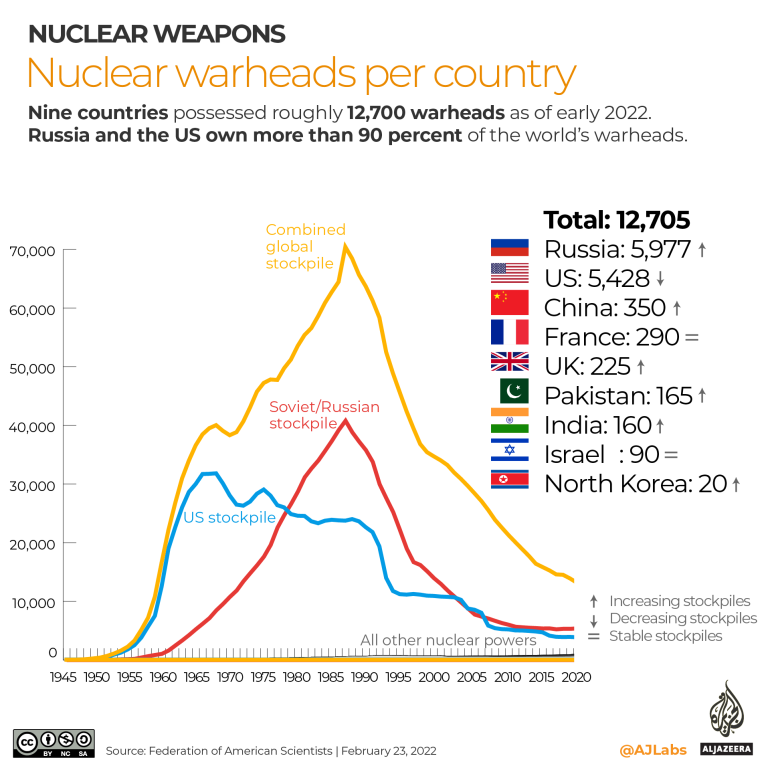
Russia with 5,977 warheads and the US, with 5,428, together still possess about 90 percent of all nuclear warheads in the world, according to the report. In 2021, the number of nuclear warheads in both countries declined further, but this was mainly due to the dismantling of discarded warheads, which the military had already abandoned years ago.
Their useable military stockpiles remained relatively stable and within the limits set by a nuclear arms reduction treaty, SIPRI said.
There was a slight reduction in the total number of nuclear warheads to an estimated 12,705 worldwide, this number will probably grow again in the course of the coming decade, the report said.
A reversing trend
For decades, the number of nuclear weapons worldwide has been decreasing steadily. It is now less than one-fifth of what was in the arsenals of the nuclear powers at the height of the Cold War in the 1980s. Last year, however, SIPRI had already identified a trend reversal towards more modern nuclear weapons.
The five UN veto powers, including China, France, Russia, the United Kingdom, and the United States – all of which are nuclear weapon states – declared at the beginning of the year their intention to take action against the further spread of nuclear weapons.
“We emphasise that nuclear war cannot be won and must never be waged,” the US said in a joint statement at the beginning of January.
But SIPRI noted that all five countries had since further expanded or modernised their arsenals. Russia had even openly threatened the possible use of nuclear weapons in the course of its war of aggression in Ukraine.
