


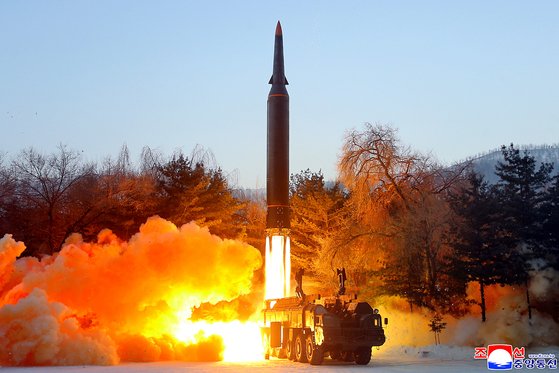
With just five days into the new year and North Korea tested its first missile of 2022. The hypersonic missile debuted during a defense exhibition in October 2021, precisely hit the target – almost 700 km away, state media reported today. This comes against the backdrop of a series of speeches by Kim Jong-un that hinted at enhancing North Korean missile defense capabilities.
It’s noteworthy that North Korea is amongst the few nations who have successfully tested hypersonic missiles. Other states on the coveted list includes the U.S., Russia and China.
A hypersonic missile flies at a lower altitude than a ballistic missile and travels at five times the speed of sound. Almost 6,200 km per hour. This makes it highly desirable since most air defenses and radar systems are unable to detect it.
During the test, first detected by Japanese coast guard early on Wednesday, a “hypersonic gliding warhead” detached from its rocket booster and maneuvered 120 km (75 miles) laterally before it “precisely hit” a target 700 km (430 miles) away.
U.S. Secretary of State Antony Blinken in a reassuring call with the Japanese Foreign Minister Yoshimasa Hayashi on Thursday, condemned the North Korea missile launch and discussed cooperation to achieve complete denuclearization and lasting peace on the Korean Peninsula.
“We take any new capability seriously, and as we’ve said, we condemn (North Korea’s) continued testing of ballistic missiles, which are destabilizing to the region and to the international community,” a State Department spokesperson said later in the evening.
While on the other hand, the Chinese foreign ministry spokesperson Wang Wenbin in his daily press briefing said, “We hope that all sides speak and act cautiously, persist in the correct direction of dialogue and consultation, and together work towards moving forward the political settlement of the peninsular question.”
Experts believe that the latest test was intended to test Pyongyang’s ability to launch hypersonic missiles in the winter. According to the Korean Central News Agency’s (KCNA) report, “the successive successes in the test launches in the hypersonic missile sector have strategic significance in that they hasten a task for modernizing strategic armed force of the state.”
It’s pertinent to mention that North Korea has not tested nuclear bombs or long-range intercontinental ballistic missiles (ICBMs) since 2017 as Pyongyang’s focus has shifted towards more maneuverable missiles and warheads that can overcome the sophisticated missile defenses deployed by South Korea and the United States.
According to Ankit Panda, a senior fellow at the Carnegie Endowment for International Peace in the US, “the North Koreans have identified hypersonic gliders as a potentially useful qualitative means to cope with missile defense.”
“They likely set up at least two separate development programmes,” he added while speaking to Reuters. “One of these was the Hwasong-8, which was tested in September. This missile, which shares a few features in common with the Hwasong-8, is another.”
The latest test – second of an hypersonic missile underlines Pyongyang’s strong commitment to modernizing its military despite harsh United Nations sanctions.
