


North Korea fired more than ten ballistic missiles into the sea on Saturday, raising tensions in the region during ongoing joint military drills between the United States and South Korea. The launches occurred as diplomatic discussions about potential talks with Pyongyang continued.
According to South Korea’s Joint Chiefs of Staff, the missiles were launched from an area near the North Korean capital Pyongyang. The launches reportedly took place at approximately 1:20 pm local time.
Military officials said the projectiles traveled toward the sea located off North Korea’s eastern coastline. The latest test quickly drew attention from neighboring countries and international observers monitoring security developments in the region.
The launches happened while Washington and Seoul were carrying out annual joint military exercises designed to improve defense readiness.
Japan Monitors Missile Activity in Nearby Waters
Authorities in Japan also tracked the missile activity. The Japan Coast Guard reported detecting what appeared to be a ballistic missile during the incident.
According to Japanese public broadcaster NHK, the projectile eventually landed in the sea. Early assessments indicated that the missile fell outside Japan’s exclusive economic zone.
Japanese officials continued to monitor the situation to ensure maritime safety. The government also issued alerts to vessels operating in nearby waters.
Ballistic missile launches by North Korea often trigger rapid monitoring by neighboring countries. Regional defense systems usually track the missiles from launch until they fall into the sea.
Although the latest missiles did not land inside Japanese territory or waters, the launches still raised security concerns.
Longstanding Missile Program and UN Sanctions
North Korea has conducted missile tests for more than two decades. These tests include both ballistic and cruise missile launches.
Experts believe the program aims to strengthen the country’s ability to deliver nuclear weapons. The country is widely believed to have successfully developed nuclear devices.
Due to these activities, the United Nations Security Council has imposed several sanctions on the country since 2006.
The sanctions target North Korea’s trade, financial networks, and defense-related imports. They were designed to slow the development of its nuclear and missile programs.
Despite these restrictions, North Korea has continued testing new weapons systems. Officials in Pyongyang often argue that such tests are necessary for national defense.
Joint US–South Korea Military Drills Continue
The missile launches came during large-scale military drills being conducted by the United States and South Korea. The exercises are held annually and involve various training scenarios.
Military officials from both countries say the drills are defensive. The goal is to improve coordination and readiness in case of potential threats from North Korea.
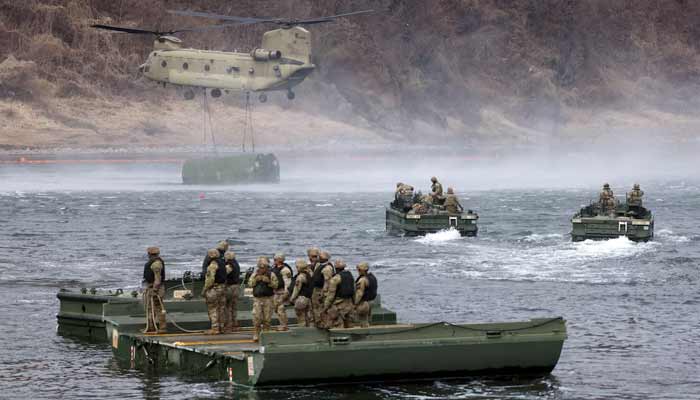
On Saturday, hundreds of troops from the two countries participated in river-crossing exercises. The training involved tanks, armored vehicles, and other heavy military equipment.
The drills were supervised by the commander of the combined US–South Korean forces.
The United States currently maintains about 28,500 troops in South Korea. These forces include air squadrons, fighter jets, and other military units stationed across the country.
North Korea has often criticized such exercises. Officials in Pyongyang frequently describe them as rehearsals for possible military aggression.
Meanwhile, diplomatic efforts remain under discussion. South Korean Prime Minister Kim Min-seok recently met Donald Trump in Washington.
The meeting focused on possible ways to restart dialogue with North Korean leader Kim Jong Un. According to South Korean officials, Trump has expressed interest in meeting Kim Jong Un if an opportunity arises.
The situation highlights the ongoing mix of military tension and diplomatic efforts on the Korean Peninsula.
