

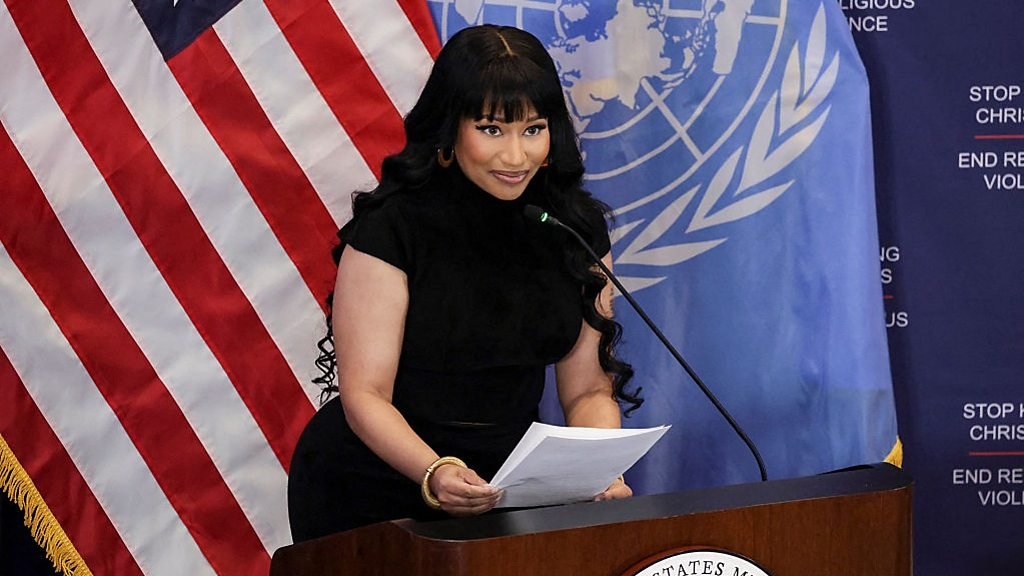

Nicki Minaj, widely known for her viral moments and high-profile controversies, took on a more serious and political role on Tuesday by endorsing a contentious foreign policy stance promoted by US President Donald Trump.
At a United Nations event in New York, Minaj appeared on behalf of the Trump administration, supporting claims that Christians in Nigeria are being uniquely targeted for persecution—a narrative experts warn oversimplifies decades-long conflicts and risks spreading misleading information.
During her remarks, Minaj closely echoed Trump’s statements. “I would like to thank President Trump for prioritizing this issue,” she said. “Today, faith is under attack in way too many places in Nigeria.
Christians are being targeted… communities live in fear constantly simply because of how they pray.” Her comments framed the issue in strictly religious terms, ignoring the broader context of Nigeria’s ongoing conflicts.
Analysts note that violence in Nigeria’s Middle Belt is rooted in a combination of ethnic, political, environmental, and economic tensions, affecting both Christians and Muslims.
By presenting the situation as a targeted campaign against Christians, Minaj aligns with narratives promoted by conservative figures and certain lobbying groups, while potentially oversimplifying a complex reality.
Minaj positioned her advocacy as an extension of her artistic and moral values, saying, “This is about standing up in the face of injustice. I will care if anyone anywhere is being persecuted for their beliefs.”
She appeared alongside US Ambassador to the UN Mike Waltz in discussions moderated by Fox News host Harris Faulkner, highlighting Trump’s efforts to combat religious violence in Nigeria. Waltz praised her as “arguably the greatest female recording artist” and commended her principled stand against injustice.
On the ground in Nigeria, experts and community leaders caution against framing the conflicts as purely religious. Both Muslim and Christian communities have suffered during recurring clashes between farmers and herders over land and resources.
By lending her global platform to this simplified narrative, Minaj risks amplifying a polarizing view, influencing public opinion, and shaping international perceptions of Nigeria’s multifaceted challenges.
