

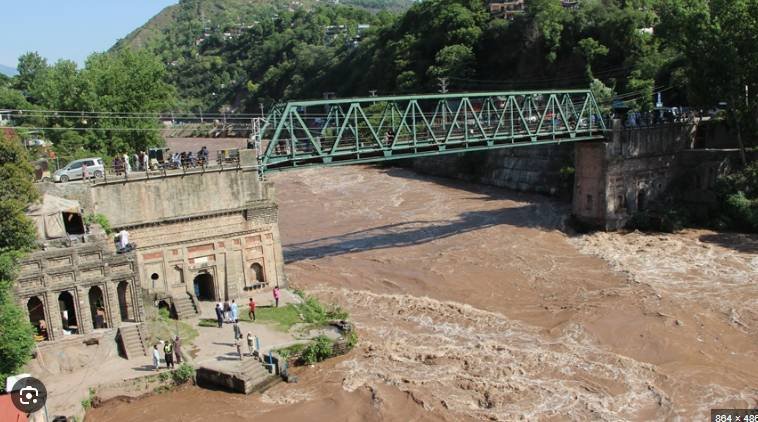

Floods and Landslides
Punjab and several other regions of Pakistan experienced widespread monsoon rainfall over the past 24 hours, prompting authorities to issue warnings of possible flooding and landslides, particularly in northern areas.
The monsoon system, which began earlier this month, has intensified, with rainfall recorded across a broad swath of the country, affecting both urban centers and mountainous terrain.
According to data provided by the Provincial Disaster Management Authority (PDMA), Khanewal recorded the highest rainfall in Punjab at 51 millimeters.
Other major rainfall figures included Sahiwal with 44 millimeters, Rawalpindi with 42 millimeters, and Murree with 41 millimeters. Lahore experienced moderate rainfall at 23 millimeters, while Okara and Mandi Bahauddin recorded 30 and 27 millimeters respectively.
The Director General of PDMA, Irfan Ali Kathia, warned that more heavy showers are expected within the next 24 hours. He urged the public to remain vigilant and avoid activities near rivers, canals, and streams.
Section 144 has been imposed around vulnerable water bodies to prevent accidents. Kathia specifically advised citizens to refrain from bathing in open water channels and avoid staying in mud or poorly constructed houses during this hazardous period.
The Pakistan Meteorological Department (PMD) confirmed ongoing monsoon activity and forecasted further thunderstorms, strong winds, and heavy downpours in parts of Punjab, Khyber Pakhtunkhwa, Gilgit-Baltistan, Kashmir, and Islamabad.
In Islamabad, 36 millimeters of rain were recorded, followed by 26 millimeters in Lahore and 23 millimeters in Sheikhupura. In Khyber Pakhtunkhwa, Balakot saw 40 millimeters, Malam Jabba 28 millimeters, and Kakul 13 millimeters of rainfall. Bagrot in Gilgit-Baltistan received 7 millimeters.
The National Disaster Management Authority (NDMA) issued a separate advisory warning of potential flooding in northern rivers and tributaries, particularly in Gilgit-Baltistan’s Hunza, Shegar, Khunjerab, Haspar, Baraldo, and Hoshe regions. Citizens and tourists have been advised to avoid unnecessary travel near riverbanks due to the risk of rising water levels and sudden flooding.
The NDMA also warned of possible landslides caused by continuous rainfall and glacial melting. Areas identified as high risk include Gilgit, Skardu, Astore, Diamer, Hunza, and Ganche in Gilgit-Baltistan, as well as several districts in Azad Jammu and Kashmir such as Muzaffarabad, Neelum Valley, and Rawalakot.
The federal disaster agency has directed all provincial authorities to stay on high alert and ensure that evacuation plans and emergency response systems are ready.
Despite the heavy rainfall, certain regions in southern Punjab may benefit from the weather. The PMD noted that overnight showers and increased soil moisture could support the growth of key summer crops such as cotton and rice in districts like Bahawalpur, Multan, and Rajanpur.
However, high temperatures persisted in parts of the country. On Tuesday, the highest temperature was recorded at 45 degrees Celsius in Nokkundi and Dalbandin, while Chilas and Turbat reported highs of 42 and 41 degrees respectively. This fluctuation in weather patterns underscores the need for continued public awareness and institutional preparedness as the monsoon season continues.
