

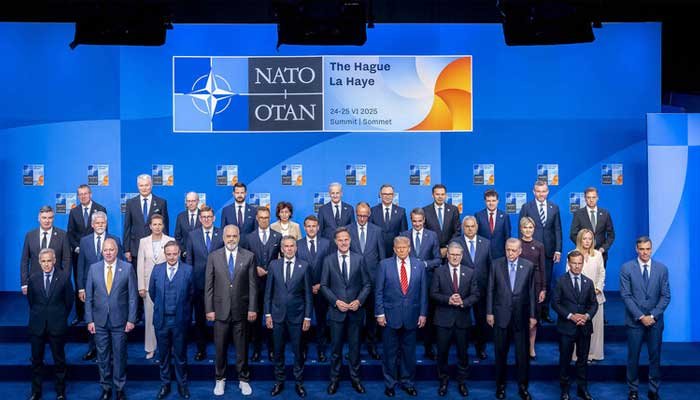

NATO leaders on Wednesday endorsed a significant increase in defense spending, aligning with a longstanding demand by U.S. President Donald Trump. The agreement, reached at a brief summit in The Hague, reaffirmed the alliance’s core principle of mutual defense, easing concerns raised by Trump’s earlier ambiguous remarks.
Trump hailed the outcome as a “great victory,” expressing hope that much of the additional military expenditure would benefit U.S. arms manufacturers. “We had a great victory here,” he declared at a press conference following the summit.
However, tensions surfaced when Trump sharply criticized Spain after Prime Minister Pedro Sanchez suggested his country could fulfill NATO obligations without meeting the new 5% of GDP target. Trump warned of economic consequences and suggested Spain would face a tougher trade deal with the U.S., saying, “That economy could be blown right out of the water when something bad happens.”
The 32-member alliance issued a concise five-point statement confirming the new defense spending goals and reiterating the commitment to Article 5 of the Washington Treaty, which considers an attack on one member as an attack on all. “We reaffirm our ironclad commitment to collective defence,” the communique read.
Pressed on his personal support for Article 5 after previous equivocation, Trump responded: “I stand with it. That’s why I’m here. If I didn’t stand with it, I wouldn’t be here.”
French President Emmanuel Macron raised concerns about Trump’s threatened tariffs on European imports, arguing that economic tensions could undermine the alliance’s unity. “We can’t say we are going to spend more and then, at the heart of NATO, launch a trade war,” Macron said, labeling the situation “an aberration.”
NATO Secretary General Mark Rutte, who hosted the summit, declared that the alliance would become “stronger, fairer and more lethal” as a result of the agreement. Praising Trump’s influence, Rutte said he deserved “all the praise” for pushing allies toward higher spending. When asked if his approach to Trump involved excessive flattery, Rutte responded that their friendship spoke for itself and left the interpretation “a matter of taste.”
Under the new targets, allies are expected to gradually raise defense spending to 5% of GDP over the next decade — with 3.5% earmarked for core military needs and 1.5% for broader security infrastructure like cyber defense and transportation upgrades. This marks a significant increase from the previous 2% benchmark, posing a major fiscal challenge for many European nations.
Ukrainian President Volodymyr Zelenskyy attended the pre-summit dinner on Tuesday but was excluded from the main summit session. He did, however, meet privately with Trump afterward.
Meanwhile, the Kremlin denounced NATO’s move as a militaristic escalation, accusing the alliance of portraying Russia as a “fiend of hell” to justify the spending surge.
