

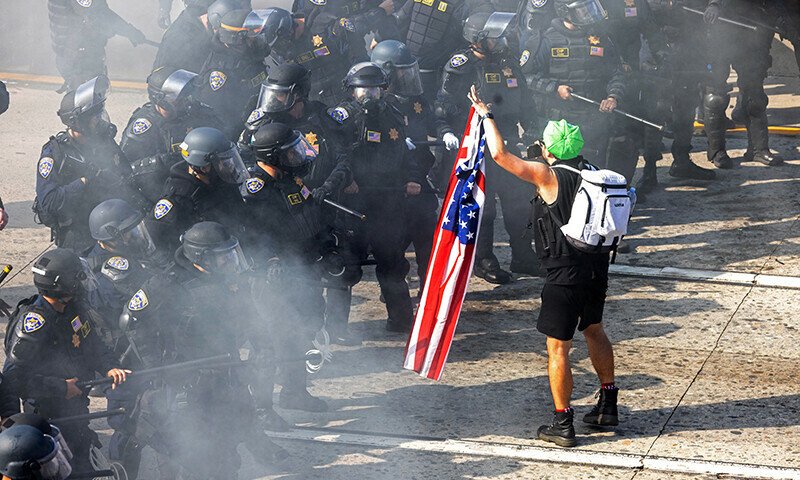

Widespread protests broke out across the United States on Wednesday, intensifying after nearly a week of demonstrations in Los Angeles, as California braced for a legal clash with the Trump administration over the controversial deployment of military forces.
In Los Angeles, over 1,000 protesters took to the streets for a sixth consecutive day. While the demonstrations remained largely peaceful, city officials enforced a second night of curfew in response to previous episodes of vandalism and looting. “Our city is not burning,” said Lynn Sturgis, 66, a retired teacher participating in the protests. “Despite what our terrible leader says, everything is calm right here.”
Elsewhere, authorities in Spokane, Washington, imposed a nighttime curfew after demonstrations erupted in opposition to President Donald Trump’s aggressive immigration enforcement tactics. “Mayor Lisa Brown has issued a curfew to begin at 9:30 p.m.,” her office announced on Facebook.
The protests, sparked by a dramatic escalation in efforts to detain undocumented migrants, have included isolated incidents of violence, such as the burning of autonomous taxis and confrontations with police. However, law enforcement, including the 8,500-strong Los Angeles Police Department, has so far managed the unrest without major incident.
President Trump, who campaigned on a hardline immigration platform, has capitalized on the moment, ordering the deployment of the California National Guard — a move that has triggered fierce pushback from state leaders. The deployment, which includes 4,700 troops — 1,000 of whom are already active — is the first of its kind in decades.
“We’re going to have a safe country,” Trump told reporters before attending a performance of Les Misérables in Washington. “If I wasn’t there, Los Angeles would have been burning to the ground.”
The Pentagon estimates the cost of the military operation at $134 million. According to Army North Deputy Commanding General Scott Sherman, the remaining troops, including 700 active-duty Marines, are currently training for civil unrest scenarios.
California Governor Gavin Newsom, a Democrat and possible 2028 presidential hopeful, has accused Trump of using the situation for political gain. “Democracy is under assault right before our eyes,” Newsom warned, arguing that the militarization could spread beyond California.
On Thursday, California attorneys are set to appear in court to request an injunction blocking military personnel from participating in immigration arrests. Federal lawyers have dismissed the legal challenge as a “crass political stunt.”
Despite Trump’s threats to expand troop deployments to other Democratic-led states, protests have spread nationwide. Demonstrations were reported in cities including Manhattan, St. Louis, Raleigh, Indianapolis, Denver, San Antonio, and Spokane.
In Texas, hundreds marched near San Antonio City Hall after Republican Governor Greg Abbott authorized the state’s National Guard to support federal agents.
Protesters are now organizing a nationwide “No Kings” movement, scheduled for Saturday — the same day Trump is expected to attend a military parade in Washington. The event, showcasing tanks and warplanes, marks the 250th anniversary of the U.S. Army and coincides with the president’s 79th birthday.
As the Trump administration portrays the unrest as a national security threat, Los Angeles Mayor Karen Bass blamed the White House for provoking the crisis. “A week ago, everything was peaceful,” she said. “The trouble began after the raids started. This is a manufactured conflict.”
Tensions remain high in cities like Downey, California, where reports of armed, unidentified men detaining Spanish-speaking residents have surfaced. A local pastor described a disturbing scene in which five armed men abducted an individual from a church parking lot and threatened her when she demanded identification. “They pointed a rifle at me and said, ‘You need to get back,’” she told local news station KTLA.
As protests continue to mount, the nation braces for what could be a pivotal confrontation over immigration policy, civil liberties, and the use of military force on American soil.
