

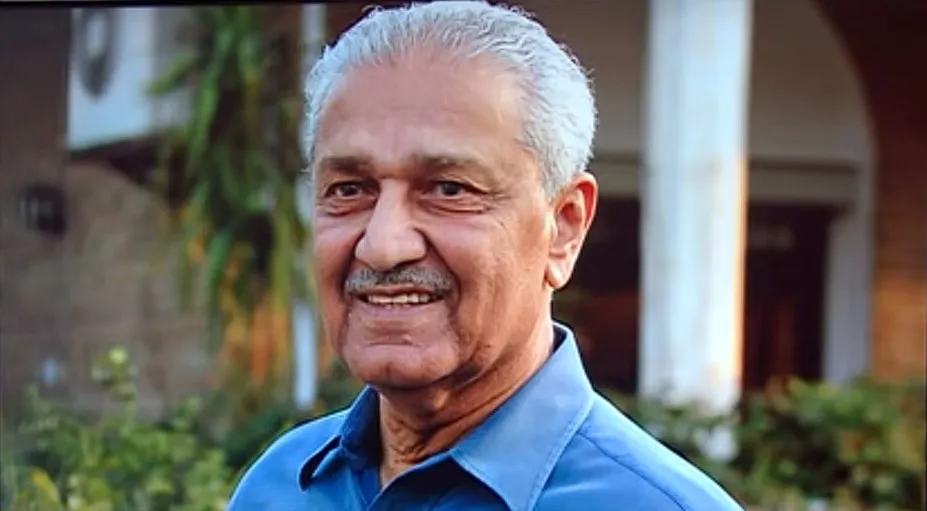

KARACHI: Nearly four years after the death of Dr Abdul Qadeer Khan, his widow, Hendrina Khan, has broken her silence, revealing that Pakistan’s celebrated nuclear scientist was betrayed by the very state he served.
In a candid interview with her granddaughter, posted on YouTube, Hendrina disclosed that Dr Khan agreed to take the fall for Pakistan’s nuclear proliferation scandal in 2004, only after receiving verbal assurances from then-president General Pervez Musharraf that he would be pardoned and placed under limited house arrest. But those promises, she said, were quickly broken.
“He accepted the role of scapegoat,” Hendrina said. “Musharraf gave his word—then within days, everything changed. That betrayal cut deeply.”
Dr Khan’s role in Pakistan’s nuclear success was back in the spotlight during the recent Youm-e-Takbeer commemorations on May 28. However, the celebrations stirred controversy when senior government officials, including Adviser to the Prime Minister Rana Sanaullah, downplayed Khan’s role.
Speaking to the media, Sanaullah said that while Dr Khan’s scientific work was respected, the title of “national hero” should go to former prime minister Nawaz Sharif, who made the political decision to conduct nuclear tests in 1998. He also credited the late Zulfikar Ali Bhutto with initiating the programme, but emphasized Sharif’s leadership as the decisive factor.
These remarks reignited debate over Dr Khan’s legacy—a complex figure at the heart of Pakistan’s most secretive and controversial strategic project. At home, he is still widely revered. Internationally, his reputation remains tainted by the proliferation scandal that saw nuclear technology shared with countries like Iran, Libya, and North Korea.
In her interview, Hendrina claimed the televised confession her husband made in 2004—taking sole responsibility for the proliferation—was given under duress. “He was assured safety and eventual rehabilitation,” she said. “But within three days, those guarantees were gone.”
The fallout from that moment was severe. Dr Khan spent years under virtual house arrest in Islamabad, cut off from public life and subjected to strict surveillance. Hendrina described the period as emotionally draining for the entire family.
“It wasn’t just him. His entire team was sidelined and humiliated,” she said. “It was deeply painful.”
Despite this, she said Dr Khan remained deeply patriotic. “He always believed in returning to Pakistan only if he could make a difference. That mission drove him, even through the hardest times.”
Hendrina also reflected on the early sacrifices the family made after relocating from Europe to Pakistan in the 1970s, when Dr Khan began work on the country’s uranium enrichment programme. “Those first years were extremely difficult,” she recalled. “We had little infrastructure, few comforts—but he never wavered.”
Dr Abdul Qadeer Khan passed away in October 2021. While the state held a formal funeral, Hendrina feels his legacy has been clouded by politics.
“His contributions have not been fully honoured,” she said. “But I believe history will ultimately recognise the role he played in securing Pakistan’s future.”
