

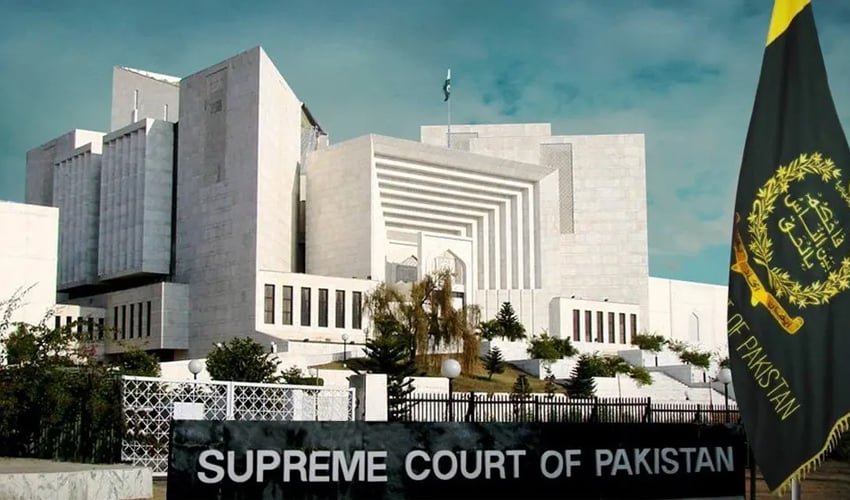

During an intra-court appeal hearing on civilian cases being tried in military courts, the Supreme Court of Pakistan raised critical questions regarding the selective application of military trials.
Justice Hassan Azhar Rizvi asked, “Why wasn’t there a military trial for the attack on Parliament? It is supreme above all. Doesn’t Parliament consider an attack on itself as contempt?” His remarks highlighted concerns over the inconsistency in trial venues for different types of offenses.
A seven-member constitutional bench, headed by Justice Amin-ud-Din Khan, examined the criteria for sending cases to military courts. Justice Muhammad Ali Mazhar pointed out an apparent procedural contradiction, saying, “It seems strange that we were first told not to discuss the Army Act sections, and then these sections were later declared void.”
Khawaja Haris, counsel for the Ministry of Defense, distinguished between protests and assaults, stating, “There is a difference between protest and assault. Political activity has its limits. Attacking state property and breaching state security is not political activity.”
Justice Rizvi emphasized the unprecedented nature of the May 9 events, noting, “In the past, people would protest at liquor stores or governor houses. This is the first time we witnessed simultaneous attacks across various cities. The crime cannot be denied.”
Justice Mazhar clarified the legal framework, explaining, “If a crime fits within the Army Act, the trial will be held in military court. The crimes are written in the law books.”
The Additional Attorney General revealed that the focus of arguments was directed toward the May 9 and 10 events, as opposed to the Army Act itself. Justice Mazhar pointed out the inconsistency in this approach.
The hearing has been adjourned until Monday, with Justice Amin-ud-Din Khan stating, “We will dedicate the entire day to this case.” Despite the defense counsel’s request for more time, Justice Musarrat Hilali remarked, “Khawaja sahib, you promise to complete your arguments every day but then fail to do so.”
