

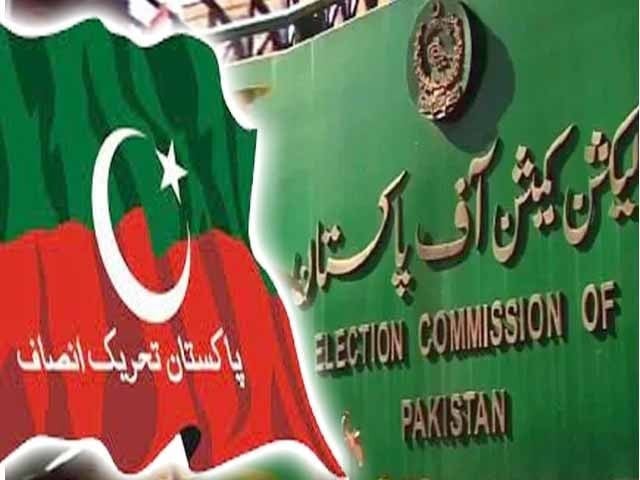

ECP reserves verdict
ISLAMABAD: The Election Commission of Pakistan (ECP) has reserved its judgment in the case concerning the distribution of reserved seats in the Khyber Pakhtunkhwa Assembly, following a detailed hearing on Monday.
A five-member bench headed by Chief Election Commissioner Sikandar Sultan Raja heard arguments from legal representatives of the PML-N, PPP, JUI, ANP, and PTI.
During the proceedings, the Chief Election Commissioner clarified that the matter under consideration strictly pertains to reserved seat allocation in Khyber Pakhtunkhwa. Lawyers presented legal interpretations, discussed party positions in the assembly, and examined the timeline and process of issuing official notifications.
The PML-N counsel argued that notifications for successful candidates were issued in two phases and emphasized the legal requirement to join a political party within three days of notification to qualify for a reserved seat. He further claimed that since PML-N and JUI hold an equal number of general seats, the reserved seats should be equally divided—nine each—and if consensus isn’t reached, a toss should decide.
ECP’s reserved seats case and experts’ arguments
PPP lawyer Nayyar Bukhari stated his party holds only four seats in the KP Assembly and emphasized that the core issue lies between PML-N and JUI, which should be resolved first.
ANP’s representative pointed out that their party’s recent by-election win also factors into the reserved seat equation and must be accounted for.
The Chief Election Commissioner noted that notifications for reserved seats were issued in two stages, with the matter involving the Sunni Ittehad Council addressed first.
After reviewing all legal arguments, the ECP reserved its decision, a ruling that could have a significant impact on the balance of power in the KP Assembly, particularly with regard to the distribution of reserved seats among competing political parties.
The ruling coalition secured more seats after the ECP’s ruling
The ruling coalition secured a two-thirds majority in the National Assembly on Wednesday after the Election Commission of Pakistan (ECP) distributed reserved seats among the PML-N, PPP, and JUI-F, in line with a recent Supreme Court verdict.
Following the top court’s ruling last week, which overturned an earlier decision granting the PTI access to reserved seats, the ECP withdrew its previous notifications that had declared PTI-backed independents as returned candidates. The Supreme Court’s Constitutional Bench, by a majority of 7-0, ruled that the PTI no longer qualifies as a parliamentary party, disqualifying it from receiving reserved seats for women and minorities.
Acting on the decision, the ECP reallocated the reserved seats in the National Assembly, awarding 13 seats to the PML-N, four to the PPP, and two to the JUI-F. This distribution pushed the ruling coalition past the 224-seat threshold needed for a two-thirds majority in the 336-member house.
According to updated figures from the National Assembly Secretariat, the treasury benches now hold 235 seats compared to the opposition’s 98. Three seats remain unfilled — one due to suspension, and two still vacant.
Provincial Assembly Allocations
Reserved seats were also reallocated in the provincial assemblies:
- Khyber Pakhtunkhwa: 10 seats to JUI-F, 7 to PML-N, 6 to PPP, and one each to PTI-Parliamentarians and ANP.
- Punjab: 23 to PML-N, 2 to PPP, and one each to PML-Q and Istehkam-i-Pakistan Party.
- Sindh: 2 seats to PPP, and one to MQM-P.
Background: Reserved Seats Controversy
The redistribution followed a legal battle that began with a March 25 order by the Peshawar High Court, which ruled that the Sunni Ittehad Council — joined by PTI-backed independents after the Feb 8 elections — was not eligible for reserved seats.
Earlier dissenting opinions from Supreme Court justices, including Justice Jamal Khan Mandokhail, had argued in favor of awarding 39 reserved seats to PTI, recognizing it as a parliamentary party. However, the recent majority ruling reversed that position, instructing the ECP to reexamine the matter and allocate seats accordingly.
The July 12, 2024 majority ruling had initially directed 41 PTI-aligned independents to submit affidavits declaring their party affiliation. But with the latest judgement, that pathway was shut down.
Justices Muhammad Ali Mazhar and Syed Hasan Azhar Rizvi, who were part of the earlier majority, later reviewed their stance and supported the petitions by PML-N, PPP, and ECP — ultimately facilitating the exclusion of PTI from the allocation process.
