

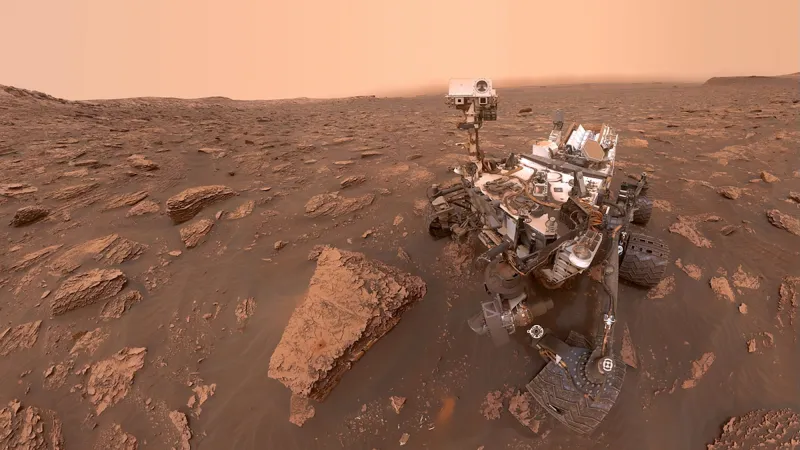

A significant discovery by NASA’s Curiosity rover has strengthened the theory that Mars once had a warm and wet environment capable of supporting life.
The rover identified large quantities of a mineral called siderite in rock samples collected from three locations within Gale Crater between 2022 and 2023. This finding suggests Mars once had a dense, carbon dioxide-rich atmosphere that could have maintained stable bodies of liquid water on its surface.
Curiosity, which has been exploring the Martian terrain since its landing in 2012, was designed to investigate whether the Red Planet ever had the conditions to support microbial life. Its latest samples, extracted from sedimentary rocks, contained up to 10.5% siderite by weight. Siderite, an iron carbonate mineral, typically forms in the presence of abundant carbon dioxide and water—two crucial elements for a warm, life-supporting climate.
The discovery indicates that ancient Mars likely had a much thicker atmosphere enriched with carbon dioxide, a powerful greenhouse gas that could have kept the planet warm enough for lakes, rivers, and possibly oceans to exist. Such a climate would have provided a potentially habitable environment for early microbial life.
Until now, detecting carbonate minerals like siderite on Mars had been rare, despite models predicting their widespread presence. This has puzzled scientists, as these minerals are expected to form when carbon dioxide interacts with surface waters. The lack of carbonate findings previously left a major gap in understanding Mars’ climatic history.
Benjamin Tutolo, a geochemist from the University of Calgary and lead author of the newly published study, noted that the rover’s findings help resolve a longstanding mystery. “If Mars required large amounts of carbon dioxide to sustain liquid water, where did it all go?” he asked. The answer may lie in the rocks themselves, which appear to have locked away significant quantities of the gas through geological processes.
Similar rock formations have been identified in various parts of Mars, suggesting that the presence of carbonate minerals could be much more extensive than previously thought. These rocks likely formed around 3.5 billion years ago when Gale Crater housed a large lake, before the Martian climate underwent a drastic transformation.
Study co-author Edwin Kite, a planetary scientist at the University of Chicago and Astera Institute, called the shift from a potentially habitable planet to a barren world the greatest known environmental catastrophe. He emphasized the importance of understanding where the carbon went, stating that the discovery of these carbon-rich rocks provides a crucial new clue.
Unlike Earth, which has plate tectonics to recycle carbon dioxide through volcanic activity, Mars lacks such a system. This has led to an imbalanced carbon cycle, with more carbon being stored in rocks than returned to the atmosphere. According to Tutolo, this imbalance is key to understanding how Mars lost its capacity to support life.
He concluded that the new data can be used to refine climate models of ancient Mars, helping scientists better understand how and why the planet transitioned from a potentially habitable world to the cold, arid landscape observed today.
