

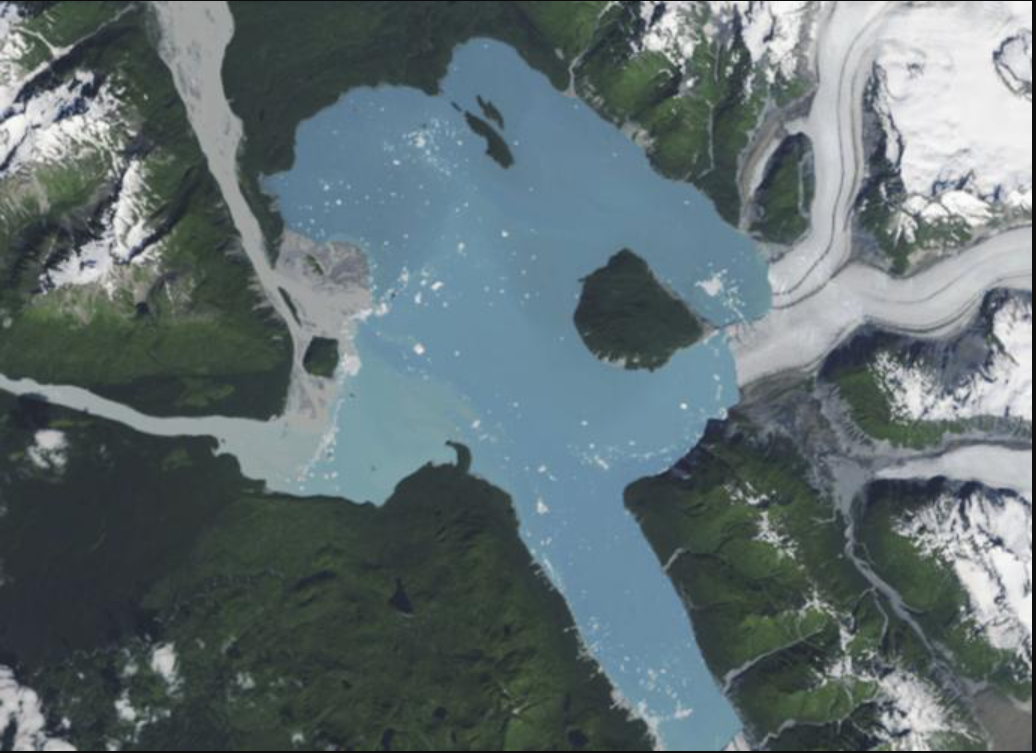

NASA scientists have confirmed the formation of a new island in Alaska following decades of glacier retreat. The island emerged when the Alsek Glacier melted, separating a small mountain from the mainland and leaving it surrounded by water.
Satellite imagery revealed this striking transformation. Images from July 5, 1984, captured by Landsat 5, compared with those from August 6, 2025, taken by Landsat 9, clearly show how the glacier has receded and exposed a new landform.
Transformation of Prow Knob
The Alsek Glacier once fully engulfed a small mountain called Prow Knob. Over four decades, the glacier’s two arms retreated by more than five kilometres. This retreat created a growing proglacial lake. Now, the latest imagery confirms that Prow Knob has become completely isolated, forming an island of about five square kilometres.
Historical Glacier Retreat
Glaciologists have monitored Alsek Glacier for many decades. In the early 20th century, the glacier ended near Gateway Knob, about five kilometres west of Prow Knob. Since then, steady retreat has been recorded, with satellite data providing detailed documentation of the process.
The melting has significantly expanded Alsek Lake. In 1984, the lake measured around 45 square kilometres. Today, it covers approximately 75 square kilometres. Its expansion has been driven not only by Alsek Glacier’s meltwater but also by nearby proglacial lakes such as Harlequin and Grand Plateau.
Link to Other Glaciers
Until around 1999, Alsek Glacier remained connected to the northern arm of the Grand Plateau Glacier. As both ice bodies receded further, their retreat contributed to the growth of Alsek Lake. Satellite imagery later showed a major new branch of the lake formed through these connections.
Emergence of the New Island
Based on data, scientists believe the island separated from the glacier between July 13 and August 6, 2025. The complete separation has also made Alsek Glacier more unstable and increasingly prone to calving. Calving occurs when large pieces of ice detach and fall into surrounding water.
Climate Change Implications
The creation of a new island highlights the rapid environmental changes taking place in Alaska due to climate change. The thinning and retreat of glaciers not only reshape landscapes but also create new ecosystems and alter hydrological systems. Scientists consider this a living example of how warming temperatures transform the natural world.
While the new island is small in size, its formation carries large implications. It demonstrates how climate-driven glacier melt contributes to new landforms and expanding lakes. Researchers will continue to monitor the Alsek Glacier and its surrounding lakes to better understand future risks.
As glaciers retreat worldwide, similar new landmasses could appear in other regions. The discovery in Alaska serves as both a scientific milestone and a reminder of the visible impacts of climate change.
