

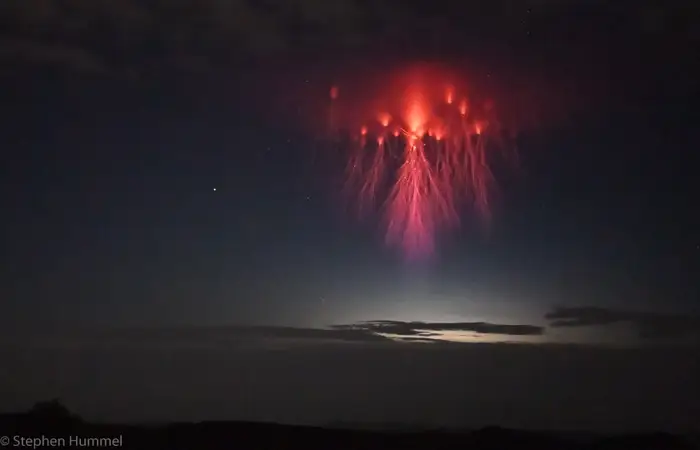

ISS astronaut Nichole Ayers recently captured a breathtaking image of a rare upper-atmosphere lightning phenomenon known as a “jellyfish sprite” while orbiting Earth aboard the International Space Station (ISS).
The spectacular burst of red light, named for its jellyfish-like tendrils, appeared above a massive thunderstorm system spanning Mexico and the southern United States, including parts of California and Texas.
“Just. Wow. As we went over Mexico and the U.S. this morning, I caught this sprite,” Ayers wrote on X (formerly Twitter). “Sprites are TLEs – Transient Luminous Events – that happen above the clouds and are triggered by intense electrical activity in thunderstorms.”
Ayers, the pilot of SpaceX’s Crew-10 mission and member of ISS Expeditions 72 and 73, snapped the image as the station passed high above the storm. The photograph has since gained wide attention among scientists and space enthusiasts for its clarity and rarity.
What Are Sprites?
Sprites are a type of Transient Luminous Event (TLE)—fleeting electrical discharges that occur high above thunderstorm clouds, often too faint or fast to be easily seen from the ground. Other TLEs include blue jets, which shoot upward from thunderclouds, and ELVES, glowing rings that rapidly expand across the upper atmosphere.
While sprites were first reported by airline pilots in the 1950s, they weren’t successfully photographed until 1989. Despite decades of study, scientists still don’t fully understand why only certain lightning strikes trigger sprites, or what exact atmospheric conditions lead to their formation.
Sprites typically appear in the mesosphere and resemble glowing red jellyfish with trailing tendrils or “carrot-shaped” flashes when less intense.
A Rare View from Space
From orbit, astronauts like Ayers have a unique vantage point to observe TLEs in real-time—offering data that’s difficult to obtain from Earth.
“We have a great view above the clouds,” Ayers noted. “So scientists can use these types of pictures to better understand the formation, characteristics, and relationship of TLEs to thunderstorms.”
Researchers hope that such high-altitude images will continue to unlock the secrets of these dazzling but mysterious lightning events—reminding us how much there still is to learn about the skies above.
