

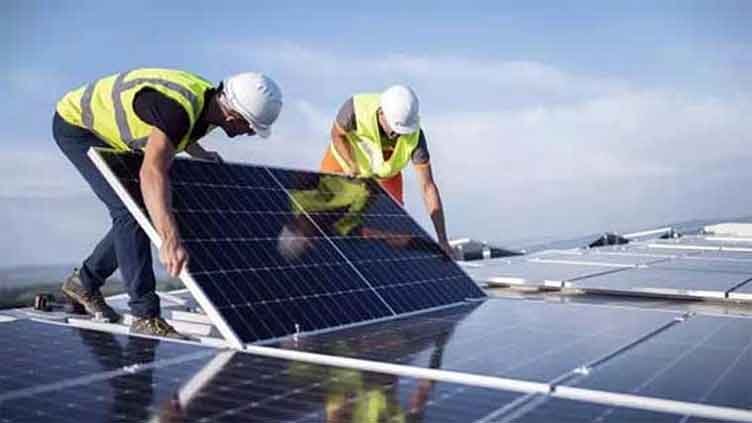

Imported Solar Panels
The National Assembly and Senate Standing Committees on Finance and Revenue have categorically rejected the government’s proposal to impose an 18 per cent sales tax on imported solar panels.
The proposal, part of the recently unveiled federal budget for the fiscal year 2025–26 by Finance Minister Muhammad Aurangzeb, sparked widespread criticism from lawmakers, who argued that such a tax would disproportionately burden citizens and hamper the adoption of renewable energy.
During a session of the NA standing committee, Federal Board of Revenue (FBR) Chairman Rashid Mahmood Langrial clarified that currently, no sales tax is applied to the import of fully assembled solar panels. However, he noted that if components of solar panels are imported separately for local assembly, they are subject to taxation.
He defended the proposed 18% GST by highlighting that the cost of solar panels has significantly decreased in recent years and projected that the new tax could generate approximately Rs20 billion in revenue for the national exchequer.
Despite this, committee members were unanimous in their opposition. Chairman Syed Naveed Qamar emphasized that all political parties had opposed the solar tax in the National Assembly, stating, “There are other ways of collecting revenue. Our position on this tax is clear—it should not be imposed.”
Member Mohammad Mobeen added that the announcement of the tax had already caused a surge in solar panel prices, making them unaffordable for the poor. “Check the market to see how much prices have increased in just two weeks,” he said.
Committee members voiced concerns that the tax would discourage solar adoption in a country where energy alternatives are already limited. MNA Shahida Akhtar Ali urged the government to tax luxury items like sugary drinks instead, while Shahram Tarakai argued that the focus should be on reducing the cost of doing business and promoting technology-based solutions like solar energy.
The Senate committee echoed similar sentiments. In a press release following its fifth session, the committee strongly recommended withdrawing the proposed tax, deeming it discriminatory and poorly timed.
Lawmakers warned that some stakeholders had already imported large quantities of solar equipment in anticipation of the tax, potentially manipulating the market. “The committee rejects the sudden imposition of GST on solar imports and urges its immediate withdrawal,” said the Senate committee chairman.
Further discussions in the NA panel also revolved around the Finance Bill 2025, which included controversial provisions granting arrest powers and money laundering notice authority to tax commissioners.
FBR Chairman Langrial clarified that the arrest powers would only apply in cases involving forgery or large-scale fraud, and only after suspects failed to respond to three notices. Arrest decisions, he added, would require approval from an internal FBR committee and inquiries would be completed within six months.
However, these assurances did little to ease lawmakers’ concerns. MNA Mobeen warned that under the new amendment, even junior officers could allege tax fraud and shift the burden of proof onto the accused, potentially leading to abuse.
Senator Saleem Mandviwalla also cautioned that such sweeping powers could result in harassment of businesses and market instability. He stressed that receiving a money laundering notice often forces businesses to shut down, even before any legal wrongdoing is proven.
The Finance Bill 2025 continues to generate heated debate, with parliamentarians urging the government to reconsider measures that may stifle business growth and hurt consumers. The rejection of the solar panel tax, however, marks a rare instance of bipartisan consensus in favor of protecting green energy and easing economic pressures on citizens.
